
Freelance Invoice: Hourly vs. Project-Based Billing
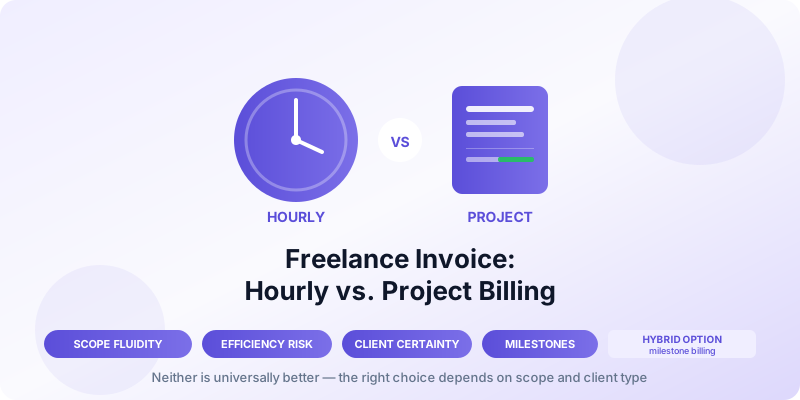
How you bill — by the hour or by the project — affects your income, your client relationships, and how you structure your invoices. Neither model is universally better. The right choice depends on the type of work, how clearly the scope is defined, and how experienced you are with estimating.
This guide breaks down both approaches, how to invoice for each, and a practical framework for choosing between them.
How Hourly Billing Works
With hourly billing, you track your time and invoice based on hours worked multiplied by your rate. Your invoice shows:
- Hours worked (broken down by task or day)
- Your hourly rate
- Total (hours × rate)
Example line items on an hourly invoice:
- Website design — 8 hrs @ $95/hr — $760
- Client calls — 1.5 hrs @ $95/hr — $142.50
- Revisions — 2 hrs @ $95/hr — $190
- Total: $1,092.50
The invoice is straightforward, but the total varies based on actual time spent. Clients see exactly what they're paying for.
When Hourly Billing Works Best
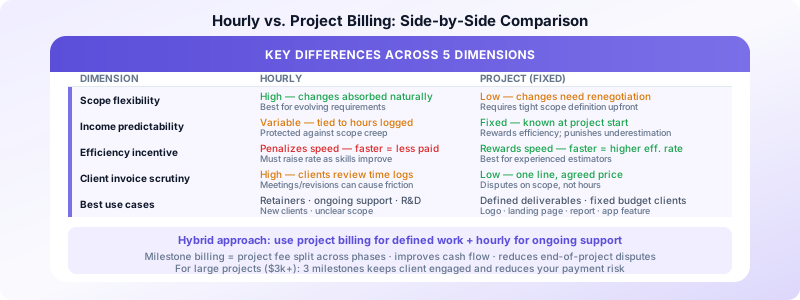
Ongoing or retainer work. Monthly maintenance, support agreements, content production at variable volume — anything where the workload shifts from month to month. Hourly keeps billing aligned with actual effort.
Undefined or evolving scope. Research projects, early-stage consulting, product development where the direction changes. When you can't predict how long something will take, hourly protects you from absorbing the cost of scope changes.
Short tasks and bug fixes. A 90-minute bug fix is hard to quote as a fixed project. Hourly is the natural fit.
New client relationships. When you don't know how a client communicates or whether they'll have scope creep tendencies, starting hourly gives you protection while you build history together.
The Main Drawback of Hourly Billing
Hourly billing penalizes efficiency. If you can complete a project in 4 hours that takes a less experienced freelancer 8 hours, you earn half as much for the same output. As your skills improve, your effective hourly rate goes down — unless you raise your rate.
Clients also scrutinize hourly invoices more carefully. Line items for meetings, revisions, or administrative tasks can generate friction even when those are legitimate parts of the work.
How Project-Based Billing Works
With project billing, you quote a fixed price for a defined deliverable. The invoice typically shows:
- Project name or description
- Fixed fee
- Payment structure (e.g., 50% upfront, 50% on delivery)
Example line items on a project invoice:
- Website redesign — 5 pages, copyediting, mobile responsive — $3,500
- Deposit (50%) — ($1,750)
- Balance due: $1,750
The total is set in advance. Clients have budget certainty; you have a clear target.
When Project Billing Works Best
Well-defined deliverables. Logo design, landing page, a specific report, an app feature with clear specs. When you know exactly what "done" looks like, project billing works.
Experienced freelancers who estimate accurately. Project billing rewards efficiency — if you complete the project in half the time you estimated, you earn more per hour. This only works if your estimates are good.
Value-based pricing situations. A project worth $10,000 to the client shouldn't necessarily be priced at 20 hours × $75. Project pricing lets you price the outcome, not just the time.
Fixed-budget clients. Many clients prefer the predictability of project pricing. It removes the anxiety of watching hours tick up.
The Main Drawback of Project Billing
Estimation risk falls entirely on you. If the project takes twice as long as expected, you absorb that cost. Poor scope definition, client-requested changes, and unexpected complexity all eat into your margin.
Scope creep is the biggest risk. A client who keeps adding small requests ("while you're in there, can you also…") can turn a profitable project into an unprofitable one quickly. A clear contract that specifies what's included — and what constitutes a change order — is essential for project billing.
How to Invoice for Each Model
Hourly invoice structure:
- Invoice date and number
- Billing period (e.g., "Week of April 14–18")
- Time log: task description, hours, rate, subtotal per line
- Total hours, total amount
- Payment terms and due date
Some clients want detailed time logs; others just want the total. Ask upfront or provide detail by default — it's easier to simplify than to add detail after a dispute.
Project invoice structure:
- Invoice date and number
- Project name and brief description
- Fixed fee (or milestone amount)
- Payment schedule if applicable (deposit, progress payment, final)
- Due date
For project billing, the invoice is simpler — one or a few line items rather than a detailed log. The detail lives in your contract or proposal, not the invoice.
Milestone Billing: A Hybrid Approach
For larger projects, milestone billing combines elements of both:
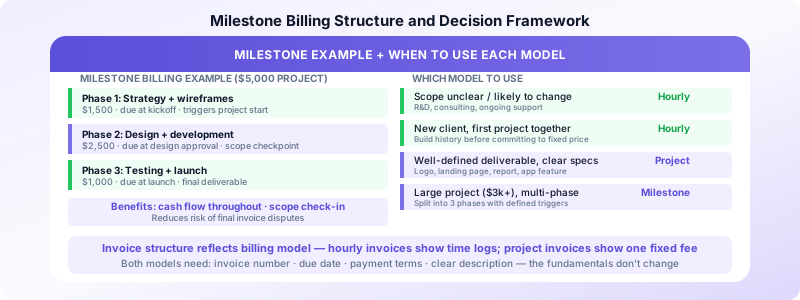
- Phase 1: Strategy and wireframes — $1,500 (due at kickoff)
- Phase 2: Design and development — $2,500 (due at design approval)
- Phase 3: Testing and launch — $1,000 (due at launch)
Milestone billing is common for projects over $3,000–$5,000. It improves cash flow (you receive payments throughout the project rather than all at the end), reduces client risk (they see progress before paying), and creates natural checkpoints for scope alignment.
Each milestone is invoiced separately, giving you a clear payment trigger and reducing the risk of a client disputing the final balance after all work is delivered.
Which Model Should You Use?
A practical decision framework:
| Situation | Recommended Model | |-----------|------------------| | Scope is unclear or likely to change | Hourly | | Ongoing maintenance or support | Hourly | | New client, unknown working style | Hourly (first project) | | Well-defined deliverable, clear specs | Project | | You estimate accurately and work efficiently | Project | | Client needs budget certainty | Project | | Large multi-phase project | Milestone | | Long-term retainer | Hourly or monthly flat rate |
Many experienced freelancers use project billing for defined work and hourly for ongoing support — keeping the structures separate makes invoicing cleaner and client expectations clearer.
Whichever model you use, the invoice fundamentals remain the same. For a refresher on what every invoice needs to include, see our guide on how to send your first invoice. For managing hourly and project invoices from your iPhone, Invoices Customers handles both billing structures in under 2 minutes per invoice.
Sources:
