
Audit-Ready Invoices: Small Business Checklist
Most small business owners don't think about invoice quality until they're facing an audit — and by then, the gaps are expensive to fix. An audit-ready invoice isn't just one that requests payment correctly; it's one that can prove, months or years later, exactly what work was done, for whom, when, and at what agreed price.
The good news: making your invoices audit-ready doesn't require extra work. It requires consistent habits applied from the start.
What the IRS Looks for in an Invoice
When the IRS reviews your income and expense records, they're looking for documentation that proves each item on your tax return. For invoices you issued (proving income) and invoices you received (proving deductions), the IRS expects:
- Who — the payer and payee clearly identified
- What — a description of the goods or services provided
- When — the date of service or delivery, and the invoice date
- How much — the amount charged, with any taxes separated
- Proof of payment — evidence the invoice was paid (bank record, payment confirmation)
An invoice missing any of these elements creates a documentation gap. Generic descriptions like "services rendered" or "consulting work" don't meet the standard — the IRS expects enough detail to verify the business purpose of each transaction.
The Audit-Ready Invoice Checklist
Use this checklist for every invoice you create:
Identity fields:
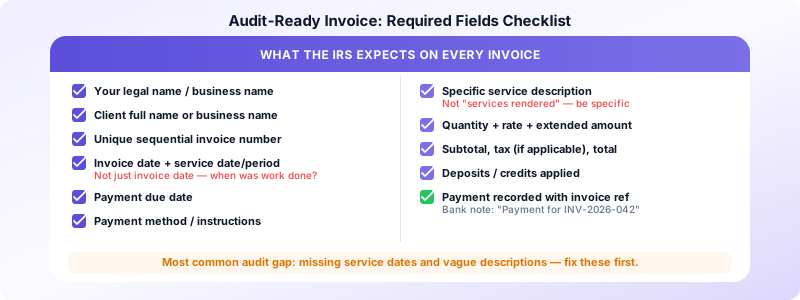
- Your legal name or business name
- Your address or city/state (especially important for home-based businesses)
- Your contact email
- Client's full legal name or business name
- Client's billing address or contact email
Invoice identification:
- Unique sequential invoice number
- Invoice date (date issued)
- Service date or date range (when work was actually performed — not just when billed)
- Payment due date
Service description:
- Specific description of each service or deliverable
- Quantity and unit (hours, sessions, items, units)
- Rate per unit and extended amount
- If project-based: reference the project name and agreed scope
Financial fields:
- Subtotal before tax
- Sales tax (if applicable) as a separate line — state and rate
- Total amount due
- Any deposits or credits applied, shown as deductions
Payment information:
- Accepted payment methods
- Account details or payment links
- Late fee policy (if applicable)
Any relevant terms:
- Cancellation policy reference (for service businesses)
- Revision limits (for creative work)
- Usage rights (for design, photography, content)
Common Invoice Gaps That Cause Audit Problems
Vague service descriptions: "Professional services — $2,000" tells an auditor nothing. What services? For what client? Over what period? Replace vague descriptions with specific ones: "Brand identity design — logo, color palette, and typography guide — Acme Coffee Roasters — March 2026."
Missing service dates: An invoice date and a service date are different. If you invoice in April for work completed in February, the invoice date alone doesn't establish when the income was earned. Include the service period: "Services: February 1–28, 2026."
No link between invoice and payment: If your bank shows a $3,500 deposit but you can't tie it to a specific invoice, that's an unexplained deposit — a common audit trigger. Always note the invoice number in payment records.
Commingled personal and business transactions: If you use the same bank account for personal and business expenses, separating them during an audit is time-consuming and error-prone. A dedicated business account is one of the most audit-protective steps you can take.
Cash payments without paper trails: Cash income is taxable and must be invoiced and reported like any other payment. If you accept cash, issue an invoice and record the payment date and amount. No invoice means no documentation.
Amended or deleted invoices without records: If you've ever adjusted a client's invoice (reduced a charge, applied a credit, issued a refund), keep the original invoice and the corrected version. Unexplained gaps in invoice numbers raise questions.
Matching Your Invoices to Tax Return Line Items
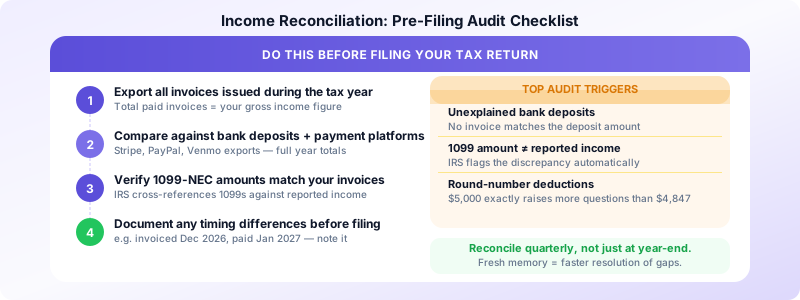
Your tax return reports gross income. The IRS can cross-reference this against 1099-NEC forms from clients who paid you $600 or more. If the numbers don't match, they investigate.
How to verify your records before filing:
- Export a full list of all invoices issued during the tax year
- Total the paid invoices — this is your gross income
- Compare against your bank deposits and payment platform totals
- Verify that 1099-NEC amounts from clients match what you invoiced and received
- Note any discrepancies and resolve them before filing
A discrepancy doesn't always mean an error — timing differences (invoiced in December, paid in January) are common and explainable. But you need the documentation to explain it if asked.
Invoices Customers stores all your invoices with issue dates, service descriptions, and payment status — giving you the complete record an auditor would request. For the full record keeping system behind audit-ready invoices, see our guide on invoice record keeping best practices.
Preparing for an Audit: What to Gather
If you receive an IRS audit notice, you'll typically have 30 days to respond with documentation. Having organized records means this is a paperwork task, not a crisis.
What to gather:
- All invoices issued in the audit year (export as PDF from your invoicing app)
- Bank statements showing income deposits
- Payment platform transaction exports (Stripe, PayPal, etc.)
- 1099-NEC forms received
- Expense receipts matching claimed deductions
- Your filed tax return for the year
What to check before sending:
- Every bank deposit has a matching invoice
- Invoice descriptions are specific and include service dates
- Any adjustments, credits, or refunds have documentation
- Sales tax collected matches sales tax remitted
Ongoing Habits That Prevent Audit Problems
Write specific descriptions every time. The habit of writing "Website redesign — homepage and 4 inner pages — BetaCo — March 2026" instead of "Web design services" takes 10 extra seconds and provides complete audit protection.
Issue invoices for every transaction, including cash. No exceptions. The invoice is your evidence of income.
Reconcile quarterly, not just at year-end. A quarterly review of invoices vs. bank deposits catches mismatches while memory is fresh. Year-end reconciliation of 12 months of records is much harder.
Keep a separate business bank account. This is the single highest-leverage audit protection step for sole proprietors and freelancers. Clean separation between personal and business transactions makes your records self-evidently credible.
Download Invoices Customers to create detailed, audit-ready invoices from your phone — with specific line item descriptions, service dates, and payment tracking built in. For IRS record retention requirements, see our guide on how long to keep invoices for tax purposes.
