
Do Freelancers Need to Charge Sales Tax?
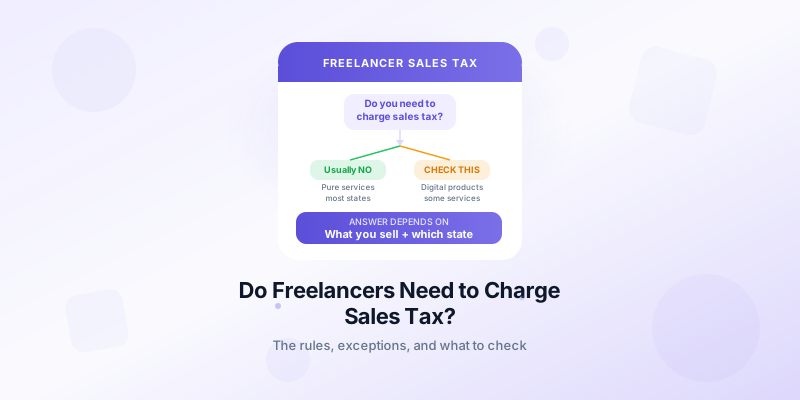
The short answer for most freelancers: no, you probably don't need to charge sales tax on your services. Most US states exempt professional services — consulting, writing, design, coaching, accounting — from sales tax. But there are exceptions that catch many freelancers off guard, and the rules have been expanding rapidly as states bring digital goods and services into their tax base.
This guide explains the rules clearly, walks through the situations where freelancers do need to collect sales tax, and helps you determine what applies to your specific situation.
The General Rule: Services Are Usually Exempt
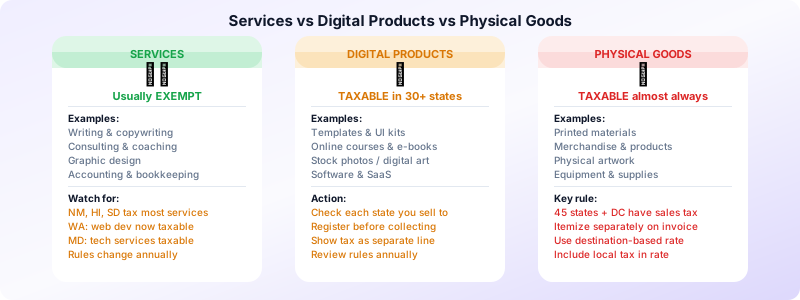
In most US states, professional services are not subject to sales tax. When you invoice a client for your time and expertise — writing copy, building a brand strategy, coaching sessions, bookkeeping — you generally don't need to add sales tax.
This is the traditional rule, and it still applies in the majority of states. States that broadly exempt services include California, New York, Florida, Texas (with some exceptions), Illinois, and most others with large freelance populations.
So if you're a freelance writer, consultant, life coach, or accountant in most states, you can invoice without collecting sales tax on your service fees.
When Freelancers DO Need to Charge Sales Tax
There are four situations where you likely need to collect:
1. You sell taxable services in a state that taxes them
A growing minority of states tax specific services that freelancers commonly provide:
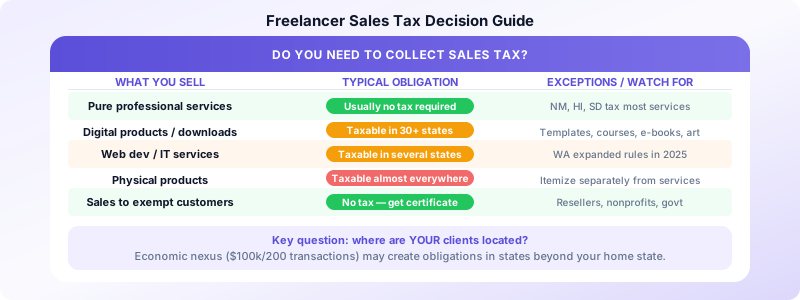
- Washington: Expanded sales tax in 2025 to cover digital advertising, IT support, website development, custom software, and several other tech-adjacent services. If you do web dev or digital marketing for Washington clients, you may have an obligation.
- New Mexico, Hawaii, and South Dakota: Broad service taxability — nearly all services are taxable here.
- Maryland: 3% sales tax on data processing, software publishing, and web hosting services (effective 2025).
- Louisiana: SaaS, digital products, and information services became taxable in 2026.
Check your state's Department of Revenue and the states where your clients are located.
2. You sell digital products
If you sell anything digital that isn't a pure service — downloadable templates, stock photos, digital art files, online courses, e-books, software, Notion/Figma templates — more than 30 states now tax these as digital goods. This is different from providing a service; it's delivering a product in digital form.
Key states taxing digital goods: California (some categories), New York, Texas, Pennsylvania, Washington, Maryland, and many others. The list grows each year.
3. You sell physical products alongside your services
If you sell physical goods — printed materials, merchandise, physical artwork, equipment — those items are taxable in virtually every state. Even if your service component is exempt, the physical product portion of a mixed invoice may be taxable.
When invoicing mixed transactions, itemize separately: "Consulting services: $2,000 (exempt)" and "Printed brand guide (physical): $150 (taxable)."
4. You have nexus in a state where your services are taxable
Even if you're based in a service-exempt state, if you cross economic nexus thresholds ($100,000 in sales or 200 transactions per year) in a state that taxes your type of work, you may owe sales tax in that state.
How to Determine Your Obligation
Work through these questions:
Step 1: What are you selling?
- Pure professional service (consulting, writing, design, coaching) → probably exempt in most states
- Digital product (template, course, download) → likely taxable in 30+ states
- Physical product → taxable in almost all states
- Software or SaaS → taxable in a growing number of states
Step 2: Where are you based? Check your home state's rules first. If you're in Washington or New Mexico, your obligation is broader than if you're in California or New York.
Step 3: Where are your clients? If you sell nationally and your volume is significant, you may have nexus in multiple states. Check the economic nexus thresholds for each state where you have substantial client revenue.
Step 4: Has your state's rules changed recently? Digital service taxation is the fastest-moving area in tax law right now. Rules that applied two years ago may have changed. Check your state's Department of Revenue annually.
What to Do If You Need to Collect
If you determine you have a sales tax obligation:
Register first. You cannot legally collect sales tax without a seller's permit from the state's Department of Revenue. Collecting without a permit exposes you to penalties.
Show tax as a separate line item. Never embed tax in your price. "Design templates: $300 / Sales tax (WA, 10.25%): $30.75 / Total: $330.75" is the correct format.
Keep records of what you collected by state. You'll need this when you file your sales tax return (monthly, quarterly, or annually depending on volume).
Remit on schedule. Late remittance triggers penalties even if you collected the correct amount.
Invoices Customers makes it easy to add a separate sales tax line to any invoice with a custom rate — so your billing stays compliant as state rules evolve. For a full overview of sales tax rules, see our guide on sales tax on invoices.
Common Misunderstandings
"I don't have a business entity, so I don't need to worry about sales tax." Sales tax obligations are based on what you sell and where, not on your business structure. Sole proprietors and single-member LLCs have the same obligations as corporations.
"My client is a business, so no sales tax." B2B sales are not automatically exempt. Business customers are only exempt if they provide a valid exemption certificate (e.g., a reseller certificate or nonprofit exemption). Otherwise, normal tax rules apply.
"I'm under the economic nexus threshold, so I'm fine." Economic nexus relates to your obligation in other states. Your home state obligation doesn't have a revenue threshold — it's based on whether your services are taxable there, regardless of volume.
"My invoicing software handles it automatically." Invoicing software can calculate rates, but it can't make compliance decisions. You still need to know whether your services are taxable and register before collecting.
The Bottom Line
Most freelancers providing pure professional services in major US states don't need to charge sales tax. But if you:
- Sell digital products or downloads
- Do web development, IT services, or digital advertising
- Are based in or sell heavily into New Mexico, Hawaii, South Dakota, Washington, or Louisiana
- Have recently crossed $100,000 in annual sales to clients in any state
...then you should verify your obligations with that state's Department of Revenue or a tax professional before your next invoice.
When in doubt, consult a tax advisor familiar with your state. The cost of getting this right proactively is far lower than the cost of back-taxes, penalties, and interest after an audit.
Download Invoices Customers to create professional invoices with or without sales tax, track payment status, and maintain the records you'll need at tax time.
