
Invoicing for Etsy Sellers and Makers
Etsy's built-in receipt system works fine for most platform sales. But if you sell wholesale, take custom orders, serve business buyers, or ship internationally, you'll hit situations where Etsy's receipt simply isn't enough. This guide explains when Etsy sellers need proper invoices, what to include, and how to create them without overcomplicating your workflow.
What Etsy's Receipt System Does (and Doesn't Do)
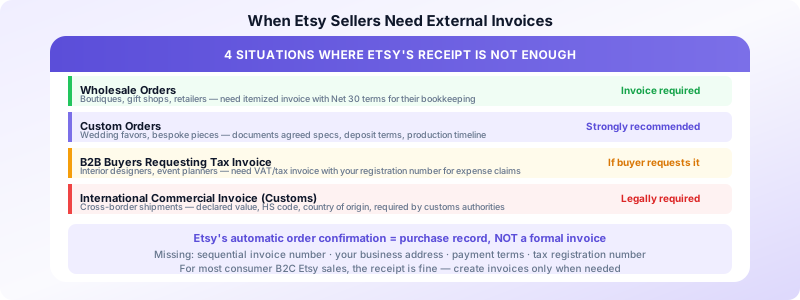
When a buyer purchases on Etsy, they automatically receive an order confirmation email. This acts as a purchase record but is not a formal invoice. It lacks:
- Your business address and contact details
- Sequential invoice numbering
- Itemized descriptions matching your buyer's needs
- Payment terms and due dates
- Tax registration numbers (required in many countries)
- Space for custom pricing negotiations
For most consumer purchases, this doesn't matter. The buyer is happy, you ship the item, done. But certain transaction types require more.
When You Need a Real Invoice
Wholesale Orders
If you sell to boutiques, gift shops, or other retailers, they need a proper invoice for their own bookkeeping. A retailer purchasing $500 in candles for resale needs to record that expense with a proper invoice that shows itemized quantities, unit prices, and your business details. Etsy's receipt won't satisfy their accounting department.
Wholesale orders also often involve:
- Net 30 payment terms (pay within 30 days of invoice)
- Deposit requirements (50% upfront, 50% on delivery)
- Partial shipments billed separately
None of these payment structures fit Etsy's checkout flow.
Custom Orders
Custom product orders frequently happen outside Etsy's standard flow — a buyer messages you about a custom wedding favor order, you agree on specs and pricing, and then payment and delivery happen over weeks. A proper invoice:
- Documents exactly what was agreed (specs, quantity, materials)
- Sets clear payment terms (deposit due now, balance due on completion)
- Protects both parties if there's a dispute
Custom orders are also more likely to involve large dollar amounts where both parties benefit from formal documentation.
B2B Buyers Requesting Tax Invoices
Business buyers — interior designers, event planners, small shops ordering supplies — often request VAT invoices or tax invoices for their business expense records. In many countries, a business can only claim a tax deduction if they have a proper invoice with the seller's tax registration number.
If a buyer emails asking for a "proper invoice" or "VAT invoice," that's your signal they need formal documentation their accountant will accept.
International Commercial Invoices
Shipping internationally requires a commercial invoice attached to the package — this is separate from your sales invoice and is required by customs. A commercial invoice for customs includes:
- Detailed description of goods (not just "handmade item")
- Country of origin
- Harmonized System (HS) tariff code
- Declared value in the destination currency
- Your business name and address
Etsy's shipping labels don't generate this automatically for all situations. For shipments above certain thresholds, or to certain countries, you'll need to create this yourself.
What to Include on Your Etsy Seller Invoice
A standard sales invoice for an Etsy seller includes:
Your information:
- Your name or shop/business name
- Address (city and country minimum; full address for formal invoices)
- Email address
- EIN or tax ID (only if required — US sole proprietors can omit for domestic B2C)
Buyer information:
- Buyer name or business name
- Billing address (for B2B orders)
Invoice details:
- Invoice number (sequential: INV-2026-001, INV-2026-002…)
- Invoice date
- Due date or payment terms (Net 14, Net 30, or "due on receipt")
Line items:
- Item description (specific enough to match what was agreed)
- Quantity
- Unit price
- Line total
Totals:
- Subtotal
- Any applicable sales tax or VAT
- Shipping (if billed separately)
- Total due
Payment instructions:
- How to pay (bank transfer, PayPal, Venmo, etc.)
- Reference to include with payment
For US domestic wholesale orders, this is sufficient. For international orders or buyers in VAT-registered countries, you may need to add your VAT or tax registration number.
Etsy Income and Record Keeping
Whether you invoice formally or not, you need to track all Etsy income for tax purposes. Etsy provides a monthly statement and an annual 1099-K (if you exceed the threshold — in 2025 this is $2,500, dropping to $600 in 2026) but that covers only on-platform sales.
If you also sell:
- Wholesale off-platform
- At craft fairs
- Through your own website
- Via direct bank transfer for custom orders
...you need to track that income separately. Keep a record of every invoice issued, whether it was paid, and when.
Good record-keeping habit: maintain a simple invoice log — a spreadsheet or invoicing app — that shows invoice number, client, amount, sent date, and paid date. This takes two minutes per invoice and saves hours at tax time. For more on record-keeping, see our guide on invoice record keeping best practices.
Setting Up a Simple Off-Platform Invoicing Workflow
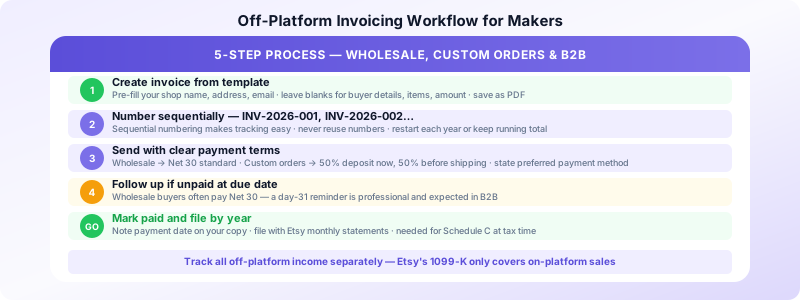
You don't need complex software to handle occasional wholesale or custom order invoices. A practical workflow for most Etsy sellers:
Step 1: Create a template. Set up a standard invoice template with your shop details pre-filled. Leave blanks for buyer details, items, and amounts.
Step 2: Number sequentially. Use a simple numbering scheme: INV-2026-001. Sequential numbering makes it easy to track what's been paid and what's outstanding.
Step 3: Send with payment instructions. Email the invoice as a PDF with your preferred payment method. For wholesale buyers, Net 30 is standard. For custom orders, specify deposit terms clearly (e.g., "50% due now to begin production, 50% due before shipping").
Step 4: Follow up if unpaid. Wholesale buyers occasionally pay late. A brief, professional reminder at day 31 is normal and expected in B2B transactions.
Step 5: Mark as paid and file. When payment arrives, note the payment date on your copy and file it by year.
For your first invoice, see our guide on how to send your first invoice — the process is the same whether you're a freelancer or a maker.
What About Sales Tax?
Sales tax for Etsy sellers is largely handled by Etsy via Marketplace Facilitator laws — in most US states, Etsy collects and remits sales tax on your behalf for platform sales. You don't need to add sales tax to orders processed through Etsy.
However, for off-platform sales (direct wholesale, custom orders paid outside Etsy), sales tax may be your responsibility depending on your state and the buyer's location. States with economic nexus thresholds (usually $100,000 in sales or 200 transactions) may require you to collect and remit tax. If your wholesale volume grows, consult a tax professional about your obligations.
For international orders, VAT is typically the buyer's responsibility in most cases under import rules — but commercial invoices still need declared values, and some B2B buyers will request formal VAT invoices.
Keeping It Simple
Most Etsy sellers don't need a sophisticated invoicing setup. If you have:
- Occasional wholesale orders: a simple invoice template emailed as PDF covers it
- Frequent custom orders: a lightweight invoicing app on your phone makes sense
- Regular international wholesale: consider an app that generates commercial invoice formats
The goal is to spend as little time on paperwork as possible while having proper documentation when buyers need it. Invoices Customers lets you create professional invoices from your iPhone in under 2 minutes — practical for makers who spend most of their time at the workbench, not behind a desk.
Start with a simple template. Upgrade your process only when the volume justifies it.
Sources:
