
Consulting Invoice Template: How to Bill Clients the Right Way
Consultants lose thousands of dollars every year not from undercharging, but from invoicing badly. Vague line items invite disputes. Missing payment terms cause delays. Inconsistent numbering creates accounting headaches. A solid consulting invoice template solves all three problems before they start.
This guide covers what every consulting invoice needs, how to structure billing for different models, and the mistakes that slow payments down.
What Every Consulting Invoice Must Include
Regardless of your billing model, every consulting invoice needs these fields:
Your business details: Name, address, phone, and email. Clients route invoices through accounts payable — they need to know who to pay.
Client details: Client company name, billing contact name, and address. Match exactly what they've given you for their records.
Invoice number: Sequential and unique — INV-2026-031. This is how both parties reference the invoice in any dispute or payment confirmation.
Invoice date and due date: Both are required. "Due upon receipt" is not a due date. Write the actual calendar date.
Itemized services: Each engagement, task, or deliverable on its own line with description, quantity or hours, rate, and total.
Payment instructions: How to pay — bank transfer, check, ACH, wire — and where (account details or remittance address).
Terms: Late fee policy and any other applicable terms. "A 1.5% monthly fee applies to balances overdue by more than 30 days" is standard.
Billing by the Hour
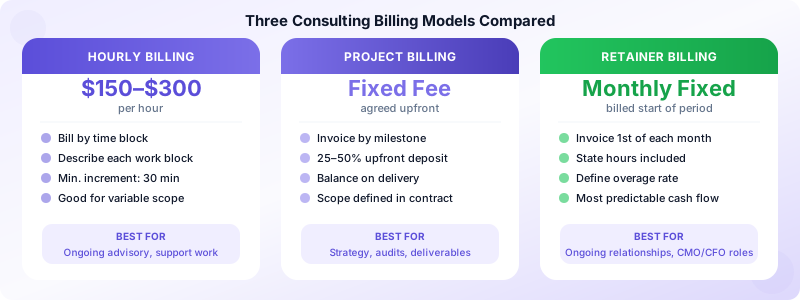
Hourly billing is the most common consulting model and the most straightforward to invoice. Each line item is a work block: date or period, description of work performed, hours, rate, and total.
Example line items for a strategy consultant:
- "Brand audit and competitor research — 4 hrs × $250 = $1,000"
- "Workshop facilitation (March 14) — 3 hrs × $250 = $750"
- "Follow-up report and recommendations — 5 hrs × $250 = $1,250"
Be specific in your descriptions. "Consulting services — 12 hours" tells the client nothing and invites questions. "Brand audit, workshop, and strategic recommendations" tells them exactly what they received.
Some consultants bill in minimum increments — half-hour or one-hour blocks. State this on your invoice or in your contract: "Billed in 30-minute increments; minimum one hour per engagement."
Billing by Project
Project-based billing is cleaner for both sides. The client knows the total upfront; you don't need to track hours. Your invoice reflects the deliverable, not the time.
Structure project invoices around milestones or phases:
- "Phase 1: Discovery and research — $3,000"
- "Phase 2: Strategy development — $4,500"
- "Phase 3: Implementation support — $2,500"
Or a single line for a fixed-fee project:
- "Brand strategy consulting — complete engagement — $10,000"
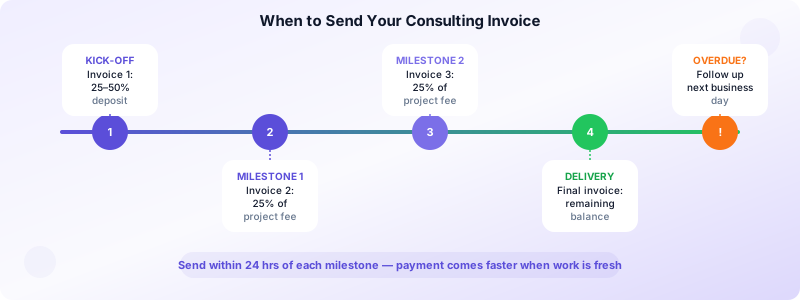
For larger projects, invoicing in installments is standard practice. Bill 25–50% upfront, with the balance split across milestones or due upon final delivery. This protects your cash flow and creates natural checkpoints.
Billing on Retainer
Retainer agreements are the most predictable billing model — and the most valuable for consultants who can secure them. You invoice a fixed monthly amount for ongoing access and work.
Retainer invoices should clearly state:
- The billing period ("April 2026 consulting retainer")
- What the retainer covers ("Up to 10 hours of strategy consulting")
- The overage rate ("Additional hours billed at $200/hr")
- Payment due date ("Due April 1, 2026")
Send retainer invoices at the start of each billing period, not at the end. You're billing for availability and commitment — payment at the start of the month reflects that.
Invoices Customers lets you create consulting invoices with custom line items for any billing model — hourly, project, or retainer — and send a professional PDF directly from your phone. For more on structuring payment terms, see our guide on invoice payment terms.
Expenses and Disbursements
If you incur expenses on behalf of a client — travel, software subscriptions, subcontractors, printing — bill them as a separate line item with receipts attached.
Itemize each expense: "Travel to client site — March 12 — $186.50 (receipt attached)" rather than a lump "expenses" line. Clients approve expenses faster when they can see exactly what they're paying for.
Agree on expense approval before the engagement starts. Some clients require pre-approval for any expense over a threshold; others are fine with a blanket approval. Either way, document it.
Consulting Invoice Timing
Send your invoice within 24 hours of completing a milestone or at the end of the billing period. Payment recency matters — clients pay quickly when the work is fresh in their minds. Waiting a week to invoice signals that payment isn't urgent to you.
For retainers, set a recurring invoice date in your calendar and treat it like a recurring expense on your business. First of the month, invoice goes out. No exceptions.
For project work, don't wait until the entire project is done if it spans multiple months. Invoice by phase or milestone so your cash flow stays steady and the client stays engaged in smaller payment decisions.
The Most Common Consulting Invoice Mistakes
Vague service descriptions. "Consulting services — $5,000" invites the client to question what they actually received. Always describe the work specifically.
No payment due date. Net 30 means payment is due 30 days from the invoice date. Without a due date, clients interpret "when convenient."
Not stating your late fee policy. If you have one, it must be on the invoice to be enforceable. If you don't have one, add it — it reduces late payments significantly.
Sending invoices to the wrong contact. Large companies route invoices through accounts payable, not through your day-to-day contact. Ask early in the engagement: "Who should I send invoices to, and what format does your AP department need?"
Forgetting to follow up. An invoice sent is not a payment received. If payment hasn't arrived by the due date, follow up the next business day — not a week later.
For a complete guide on following up on unpaid invoices, see our post on how to follow up on unpaid invoices.
Download Invoices Customers to create professional consulting invoices with any billing structure — no account needed, all your client data stays on your device.
