
Cross-Border Payment Methods for Freelancers: Full Guide
Getting paid by international clients sounds simple until you see how much disappears in fees and poor exchange rates. A $2,000 invoice can net you $1,850 or $1,940 depending entirely on which payment method you and your client use. Cross-border payment methods for freelancers vary dramatically in cost, speed, and convenience — and the differences are worth knowing.
This guide compares the main options so you can choose the right one for each client relationship.
Why Payment Method Choice Matters More Than You Think
Most freelancers focus on setting the right rate, then let payment method become an afterthought. But currency conversion markup alone can cost you 2-4% on every international payment. On $5,000/month in international income, that's $100-$200 lost every month — $1,200-$2,400 per year.
There are four main cost categories to watch:
- Transfer fees — flat or percentage fees charged by the platform
- Exchange rate markup — how far the offered rate sits from the true mid-market rate
- Receiving fees — some platforms charge the recipient to receive funds
- Withdrawal fees — moving money from a platform wallet to your bank
The total cost is what matters, not just the headline fee. A platform advertising "no transfer fee" often recovers its margin through exchange rate markup.
Wise (Formerly TransferWise)
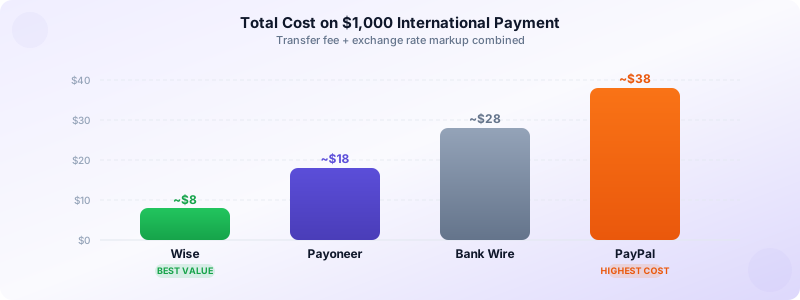
Wise has become the benchmark for international freelancer payments. It uses the mid-market exchange rate (the real rate you see on Google) and charges a transparent fee of roughly 0.5–1.5% depending on the currency corridor.
Pros:
- Mid-market exchange rate — no hidden markup
- Fast: most transfers complete in 1–2 business days
- Wise account gives you local bank details in multiple currencies (USD, EUR, GBP, AUD, etc.)
- Clients can pay you in their local currency; you receive in yours
Cons:
- Not available in every country
- Some currency corridors have higher fees
- Not ideal for very small amounts (fixed fee component)
For freelancers with regular international clients, Wise is usually the lowest-cost option. Setting up a Wise account gives you a multi-currency account number — you send clients your USD or EUR details, they pay locally, and Wise handles the conversion at minimal cost.
PayPal
PayPal is the most familiar option, but familiarity comes at a price. PayPal charges 3–4% currency conversion markup on top of its transaction fees. On a $1,000 payment, that can mean $40–$50 extra cost versus a more efficient platform.
Pros:
- Universally recognized — clients in almost every country have PayPal accounts
- Fast: instant platform-to-platform transfers
- Offers buyer/seller protection on goods (less relevant for services)
- Easy to request payment with an invoice link
Cons:
- Currency conversion markup of 3–4% is consistently among the highest
- Fees on international payments add up quickly
- PayPal can hold funds if account activity looks unusual
- Not available in some countries (China, etc.)
PayPal works best for smaller, one-off payments where the client strongly prefers it, or when convenience outweighs cost. For ongoing client relationships with regular payments, the fees accumulate significantly.
Bank Wire Transfers (SWIFT)
A traditional bank wire transfer is the default for larger transactions and more conservative clients. It's universally accepted and reliable — but the hidden costs are real.
Pros:
- Works everywhere globally
- No platform dependency — no account needed from client
- Often preferred by larger businesses and agencies
Cons:
- Fees: typically $20–$50 per wire from the sending bank
- Exchange rate markup: banks add 1.5–3% above mid-market rate
- Slow: 3–5 business days is common, sometimes longer
- Intermediary bank fees can be deducted mid-transfer, arriving short
Bank wires become competitive for transactions over $10,000–$15,000 where the fixed fee is a small percentage. For regular freelance invoices in the $500–$3,000 range, they're expensive compared to modern alternatives.
Payoneer
Payoneer is built specifically for freelancers and remote workers. It provides you with a US bank account number, EU IBAN, and UK account details — making it easy for international clients to pay you via local transfer.
Pros:
- Designed for freelancers and contractors
- Local receiving accounts in major currencies
- Low fees when Payoneer-to-Payoneer (1%)
- Integrates with many freelance platforms (Upwork, Fiverr, etc.)
Cons:
- Exchange rates add a markup (typically 1.5–2% above mid-market)
- Annual fee charged if balance is low or account is inactive
- Withdrawal to local bank can take 2–5 business days
Payoneer is a solid option, particularly if your clients are already on major freelance platforms. For direct client relationships, Wise often edges it out on cost.
Stripe (For Invoice-Based Payments)
If you send invoices and want clients to pay by card, Stripe lets you accept credit and debit cards internationally. It's not a transfer platform — it's a payment processor — but it's worth mentioning for freelancers who invoice clients.
Pros:
- Clients pay by card — familiar and convenient
- Can embed payment links in invoices or emails
- Automatic currency handling
Cons:
- 2.9% + $0.30 per transaction base fee, plus additional cross-border fees
- Not available as a payout method (you receive in your home currency)
- Adds cost primarily to your client's side if they pay in a foreign card
Invoices Customers lets you create professional invoices that you can send directly to international clients, with your preferred payment instructions clearly stated. Include your Wise account details, Payoneer bank number, or any payment method your client prefers.
How to State Payment Terms on International Invoices
Regardless of which method you use, always specify on the invoice:
- Which payment method you accept
- Who bears the transfer fee (you or the client)
- The currency the invoice is denominated in
- Payment due date
A common approach: "Payment due within 14 days. Please send via Wise to [email/account]. Client is responsible for all transfer fees." This avoids ambiguity about short payments due to intermediary fees.
For more on structuring invoice payment terms, see our guide on how to write payment terms on an invoice. For the broader topic of working with clients abroad, see our post on how to invoice international clients.
Choosing the Right Method
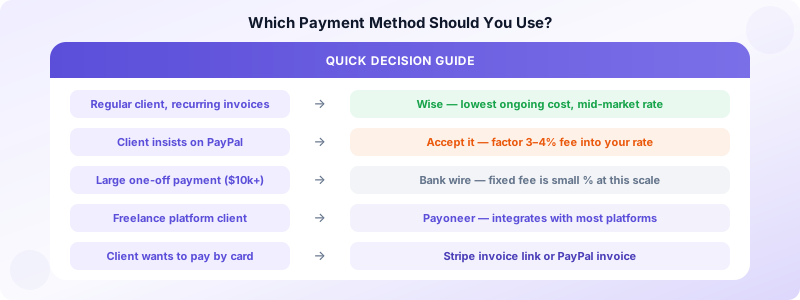
No single method is best for every situation. Here's a quick decision guide:
- Regular client, recurring payments: Wise or Payoneer — lowest ongoing cost
- Client insists on PayPal: Accept it, but factor the fees into your rate
- Large one-off payment ($10k+): Bank wire may be fine at this scale
- Client wants to pay by card: Stripe or PayPal invoice link
- Freelance platform client: Use the platform's built-in system (Payoneer often integrates)
Once you have a working payment setup with a client, stick with it. Consistency reduces payment friction and gets you paid faster.
Download Invoices Customers to create polished invoices with your payment details included — no account needed, all data on your device.
