
How to Invoice International Clients the Right Way
You just landed your first overseas client. The project goes smoothly, the deadline is met, and now it is time to send the invoice. But which currency should you use? Do you need a VAT number? Will the payment actually arrive in your bank account without losing a chunk to fees? Invoicing international clients raises questions that domestic billing never does — and getting the answers wrong can cost you weeks of delayed payments.
Cross-border projects are now routine for freelancers and small business owners. Yet many still treat international invoicing as an afterthought, leading to rejected invoices and avoidable cash flow gaps. This guide walks you through everything you need — from choosing the right currency to staying compliant with tax rules across borders.
Why International Invoicing Is Different
When you invoice a domestic client, the rules are straightforward. You both use the same currency, follow the same tax laws, and rely on the same banking infrastructure. International invoicing removes all three of those assumptions.
Currency differences mean you need to decide who absorbs exchange rate risk. A rate that looked favorable when you sent the invoice might shift by the time the client pays two weeks later.
Tax and compliance requirements vary by country. Some jurisdictions require specific tax identification numbers on invoices. Others mandate a reverse-charge mechanism for cross-border services. Sending an invoice without the correct tax treatment can trigger processing delays.
Payment infrastructure adds friction. International wire transfers often involve intermediary banks that deduct fees along the way. A $5,000 invoice might arrive as $4,920 in your account if you have not planned the payment route carefully.
Language and formatting also matter. Date formats, number separators, and currency symbol positions vary across countries. An invoice that reads clearly to you might confuse a client in another region.
Essential Elements of an International Invoice
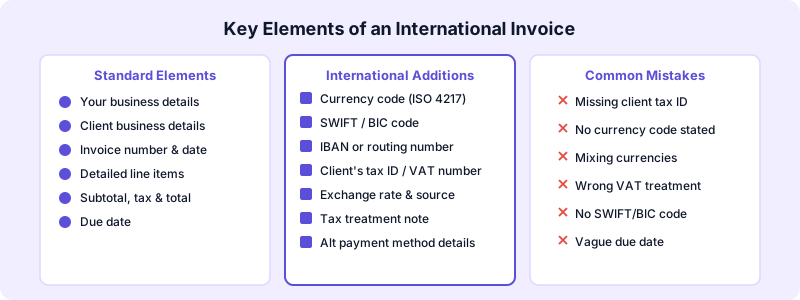
Every international invoice needs the standard elements you would include on any invoice — but with a few critical additions. If you need a refresher on the basics, check our complete guide on what to include on an invoice.
Your full business details. Include your legal business name, address, email, phone number, and any registration numbers required in your country. For U.S. freelancers, this means your EIN or SSN. For EU-based businesses, include your VAT identification number.
Your client's full business details. List the client's legal name, registered address, and tax identification number. Many countries require the buyer's tax ID for the invoice to be processed. Ask for this information upfront.
Invoice number and issue date. Use a consistent numbering system. Write explicit dates like "Due April 22, 2026" rather than just "Net 30" to eliminate confusion across time zones.
Detailed line items with currency. Break down your services into specific line items. State the currency code (USD, EUR, GBP) next to every monetary amount — never assume your client knows which currency you mean.
Payment instructions. Include your bank name, SWIFT/BIC code, IBAN (for European transfers), and account number. If you accept payments through platforms like Wise or PayPal, list those details too. The easier you make it for the client to pay, the faster the money arrives.
Applicable tax information. State whether your invoice includes VAT, GST, or any other tax. If the reverse-charge mechanism applies, note this explicitly. A missing tax note can cause the client's finance team to reject the invoice.
How to Handle Currency and Exchange Rates
Currency decisions affect both your client relationship and your bottom line. There are three common approaches.
Invoice in your home currency. Your accounting stays clean and you know exactly what you are billing. The downside is that your client absorbs the exchange rate risk and may factor that uncertainty into future negotiations.
Invoice in the client's currency. This makes life easier for the client's accounts payable team, but you carry the exchange rate risk. For Net 30 or longer, fluctuations can eat into your margins.
Agree on a fixed exchange rate in the contract. For ongoing relationships, agree on a specific rate or rate source (like the ECB mid-market rate on the invoice date) in your contract. This eliminates surprises for both parties.
Whichever approach you choose, always state the exchange rate source and date on the invoice itself. This prevents disputes when the payment amount does not match expectations.
Practical tips for managing currency risk:
- Set shorter payment terms for international invoices. Net 15 reduces your exposure to rate fluctuations compared to Net 30.
- Consider using a multi-currency account to hold funds in the client's currency until rates are favorable.
- For large projects, request milestone payments rather than a single payment at completion. Smaller, more frequent payments reduce the impact of any single rate swing.
- Always use the same currency for the entire invoice. Mixing currencies within one document creates accounting headaches for everyone.
Payment Methods for International Clients
Choosing the right payment method can mean the difference between receiving your full invoice amount and losing a portion to fees.
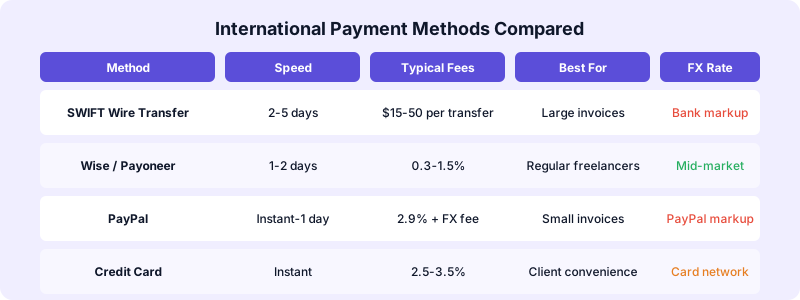
International wire transfer (SWIFT). The traditional method for large payments. Wire transfers are reliable but intermediary banks may deduct fees along the way. Expect to pay $15-50 per transfer, and allow 2-5 business days for the payment to arrive.
Online payment platforms. Services like Wise, Payoneer, and PayPal offer faster, cheaper alternatives. Wise uses the mid-market exchange rate with a transparent fee, making it popular among freelancers. These platforms typically deliver funds within 1-2 business days.
Multi-currency accounts. If you regularly invoice in different currencies, a multi-currency account lets you receive payments without immediate conversion. You can convert when rates are favorable.
Credit card payments. Convenient for smaller invoices but comes with processing fees (typically 2.5-3.5%) that either you or the client must absorb.
The best approach for most freelancers is to offer two payment methods — a primary option and a backup. Include clear instructions for both on every invoice. When invoicing as a freelancer, reliable payment infrastructure is just as important as the invoice itself.
Tax and Compliance Considerations
Tax compliance is where international invoicing gets most complex. The rules depend on where you and your client are based, and what type of service you provide.
VAT and the reverse-charge mechanism. If you sell services to a business in another EU country, the reverse-charge mechanism typically applies — you do not charge VAT, and the client accounts for it in their country. Note this on the invoice. If you are outside the EU selling to an EU business, VAT generally does not apply, but still note the exemption.
U.S. tax considerations. U.S. freelancers generally do not charge sales tax on services exported to foreign clients. However, you must still report this income to the IRS using the exchange rate on the day you received the funds.
Withholding tax. Some countries require clients to withhold a percentage of your payment for tax purposes. If your client's country has a tax treaty with yours, the withholding rate may be reduced. Request a certificate of tax residency from your tax authority to claim treaty benefits.
Record-keeping requirements. Maintain copies of every international invoice, payment confirmation, and exchange rate used. Many jurisdictions require you to keep these records for 5-7 years.
When in doubt, consult a professional. International tax law is nuanced, and the cost of getting it wrong far outweighs the cost of a consultation with a cross-border tax advisor.
Simplify International Invoicing with the Right Tools
International invoicing does not have to be complicated. The key is building a repeatable process and using tools that handle the details for you.
Start by creating an international invoice template with all the elements covered in this guide — complete business details, clear currency codes, SWIFT/IBAN details, and proper tax notations. Save it so you can reuse it for every international client.
Invoices Customers makes this straightforward. Create professional invoices with all the necessary details, manage client information including international addresses and tax IDs, and generate polished PDFs — all from your iPhone. The app works offline and stores data locally on your device, so you can invoice even when traveling internationally.
Here is a simple checklist to follow before sending any international invoice:
- Verify the client's full legal name, address, and tax ID
- Confirm the agreed currency and state the exchange rate source
- Include your SWIFT/BIC code and IBAN (or alternative payment details)
- Add the correct tax treatment (VAT, reverse charge, or exemption note)
- Write the due date as a specific calendar date, not just "Net 30"
- Double-check that all monetary amounts use the same currency code
With Invoices Customers, you can set up client details once, build your template with all the required international elements, and send professional invoices to clients anywhere in the world — in seconds.
Download Invoices Customers free on the App Store and start invoicing your international clients with confidence today.
