
Event Planner Invoice Example: How to Bill Clients
Event planning invoicing is more complex than most service businesses. You're managing deposits, milestone payments, vendor pass-throughs, and final settlements — often across months of planning. A poorly structured invoice creates confusion about what's been paid, what's owed, and what's included in your fee.
This guide walks through what to include on an event planner invoice, how to structure multi-payment projects, and how to handle the line items that cause the most disputes.
What to Include on an Event Planner Invoice
Your business name and contact info: Company name, email, phone, and website. Event planners often work under a business name rather than a personal name — use it consistently on all client-facing documents.
Client details: Client name, company (for corporate events), and the specific billing contact. For weddings, confirm early whether the couple is paying or if family members are involved — invoices sent to the wrong person cause delays.
Invoice number and dates: Sequential invoice number, issue date, and due date. For milestone invoices, label them clearly: "Invoice 1 of 3 — Deposit" so clients understand the payment structure upfront.
Event details: Event name, date, and venue. "Henderson-Park Wedding Reception — October 18, 2026 — The Rosewood Hotel" makes the invoice immediately identifiable and easier to match against contracts.
Itemized services: Each service as a separate line item. Don't lump everything into "event planning services." Break it out: planning coordination, vendor sourcing, day-of coordination, setup supervision, etc.
Vendor costs (pass-through): If you pay vendors and bill the client, list these separately from your fee. "Florist — Bloom & Branch (pass-through): $2,400." This keeps your fee transparent and the vendor costs visible.
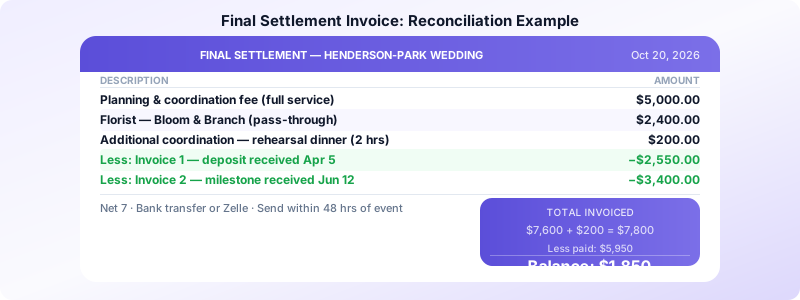
Deposit/prior payment credit: Always show prior payments as a credit on subsequent invoices. "Less: deposit received April 5: −$1,500." Without this, clients can't verify their running balance.
Payment instructions: Accepted methods, account details, and any wire transfer instructions for larger amounts.
Event Planner Fee Structures
How you charge affects how you invoice. The three main models:
Flat fee: A fixed price for defined scope. Common for day-of coordination ($800–$3,000) and smaller events. Simple to invoice — one or two payments.
Percentage of event budget: 10–20% of the total event spend. Standard for full-service wedding and corporate planning. Invoice against the estimated budget, then reconcile when actuals are known.
Hourly rate: $50–$150/hr for freelance planners, depending on experience and market. Used for partial services or consulting. Invoice weekly or monthly with an hours log.
Corporate events typically command a 20–30% premium over comparable social events due to stricter deliverable requirements, multiple stakeholders, and formal reporting.
How to Structure Milestone Payments
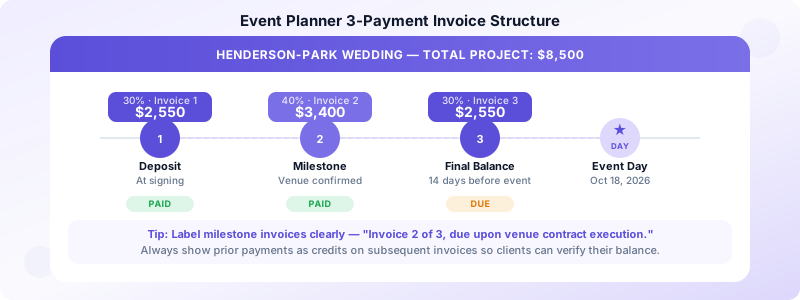
For events with budgets over $2,000, a multi-payment structure protects both you and the client. The most common breakdown:
3-payment model:
- 30% deposit at contract signing — secures your time and covers early vendor deposits
- 40% at a defined milestone (e.g., 60 days before event, after venue is booked, after menu finalized)
- 30% final balance due 7–14 days before the event or on delivery
2-payment model (simpler):
- 50% deposit upfront
- 50% balance due 14 days before the event
Always define the milestone trigger precisely in your contract and reference it on the invoice: "Milestone 2 — due upon venue contract execution." Vague milestones ("when planning is underway") lead to disputes about when payment is owed.
For day-of coordination, a 50/50 split is standard: half on booking, half on completion.
Handling Vendor Pass-Throughs
Many event planners pay vendors directly and bill the client as a pass-through. How you handle this on the invoice matters:
Option 1: Separate line items at cost. List each vendor at what you paid, with receipts available on request. Your planning fee is a separate line item. Maximum transparency — clients can see exactly what went to vendors vs. your fee.
Option 2: Itemized with markup. List vendors at a marked-up rate (typically 10–15%) to cover your coordination overhead. If you use this model, disclose it in your contract — surprises on invoices erode trust.
Option 3: Bundled estimate. Invoice an estimated total for vendor costs, then issue a reconciliation invoice after the event for the actual amounts. Note clearly: "Vendor costs estimated — final reconciliation invoice to follow."
Whichever model you use, be consistent and explain it in your client onboarding so the invoice doesn't raise questions.
Deposit and Cancellation Terms
Deposits protect you when events are cancelled after you've committed time and turned away other work. Standard terms:
- Deposit is non-refundable if cancelled within 60–90 days of the event
- Full cancellation: Client pays the deposit plus any vendor costs you've already committed
- Partial cancellation (scope reduction mid-planning): Invoice for work completed to date at your hourly rate, plus any non-refundable vendor deposits
State your cancellation policy as a note on every invoice: "Deposits are non-refundable within 90 days of event date. Full planning fee is due if cancelled within 30 days."
Invoices Customers makes it easy to add custom notes to every invoice — including cancellation terms, deposit credits, and payment instructions — so nothing gets missed on client-facing documents. For guidance on following up when invoices aren't paid, see our post on how to follow up on unpaid invoices.
Final Settlement Invoice
After the event, issue a final reconciliation invoice covering:
- Any remaining balance on your planning fee
- Vendor cost reconciliation if actuals differed from estimates
- Additional hours for scope additions (extra guests, added services, late changes)
- Deductions for any services not delivered
Label it clearly: "Final Settlement Invoice — Henderson-Park Wedding." Include a running summary: "Total project value: $8,500. Previously invoiced: $7,500. Balance this invoice: $1,000."
Send the final invoice within 48 hours of the event while everything is fresh. Waiting weeks to invoice makes clients question line items and slows payment.
Getting Paid on Time as an Event Planner
Tie milestone invoices to clear triggers. "Invoice due upon venue contract execution" gets paid faster than "Invoice 2 — due in 30 days." When the trigger is an action the client just took, they're engaged and ready to pay.
Never start vendor negotiations without a signed contract and deposit. Your leverage disappears once you've started working.
Chase late payments promptly. A milestone invoice 7 days past due is a week closer to your next event commitment. Send a brief reminder on day 8: "Just checking in on Invoice 2 for the Henderson-Park event, due last Wednesday."
Build late fees into your contract and invoice notes. "Invoices unpaid after 14 days incur a 1.5% monthly late fee." This is standard in the industry and most clients pay before the fee kicks in.
Download Invoices Customers to manage multi-payment event projects from your phone — create milestone invoices, track deposits, and store client details in one place. See our guide on how to create professional invoices for a complete invoicing setup walkthrough.
