
Freelancer Quarterly Tax Payments: A Complete Guide
If you freelance, you do not get taxes automatically withheld from your income. That means the IRS expects you to pay as you earn — four times a year through quarterly estimated tax payments. Miss a deadline or underpay, and you face penalties that chip away at your hard-earned income.
Freelancer quarterly tax payments trip up many self-employed professionals, especially those in their first year. But once you understand the system, staying on top of your obligations becomes straightforward. This guide walks you through everything you need to know: who must pay, when payments are due, how to calculate what you owe, and how to avoid the most common mistakes.
Who Needs to Make Quarterly Tax Payments?
Not every freelancer must make quarterly payments, but most do. The IRS requires estimated tax payments if you expect to owe $1,000 or more in federal taxes for the year after subtracting withholding and refundable credits.
As a rule of thumb, if your net self-employment income exceeds roughly $5,000 for the year, you almost certainly need to make quarterly payments. You should plan for them if any of the following apply:
- You earn income as a freelancer, consultant, or independent contractor
- You have a side business on top of a salaried job (and your W-2 withholding does not cover the extra tax)
- You receive 1099 income from clients
- You earn rental, investment, or other non-withheld income above the threshold
If you also hold a traditional job, one alternative is to ask your employer to increase your W-2 withholding to cover the additional tax from freelancing.
2026 Quarterly Tax Due Dates
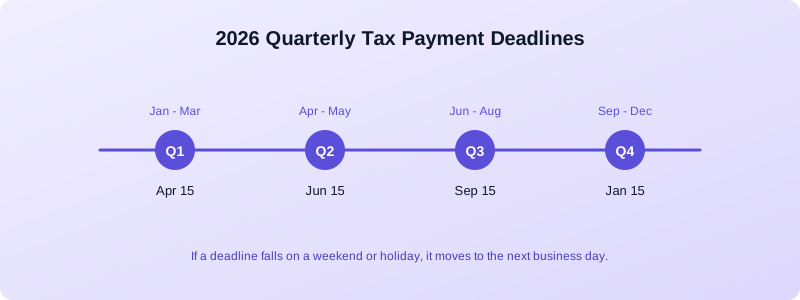
The IRS divides the tax year into four uneven payment periods. Here are the 2026 deadlines:
- Quarter 1 (January through March): April 15, 2026
- Quarter 2 (April through May): June 15, 2026
- Quarter 3 (June through August): September 15, 2026
- Quarter 4 (September through December): January 15, 2027
Notice that the periods are not equal. Quarter 2 covers only two months while Quarter 3 covers three. Mark every deadline in your calendar now so you never get caught off guard. If a due date falls on a weekend or federal holiday, the IRS moves it to the next business day.
After your final quarterly payment in January 2027, you will file your annual tax return by April 2027. Any overpayment gets refunded or applied to next year's estimated taxes.
How to Calculate Your Quarterly Payments
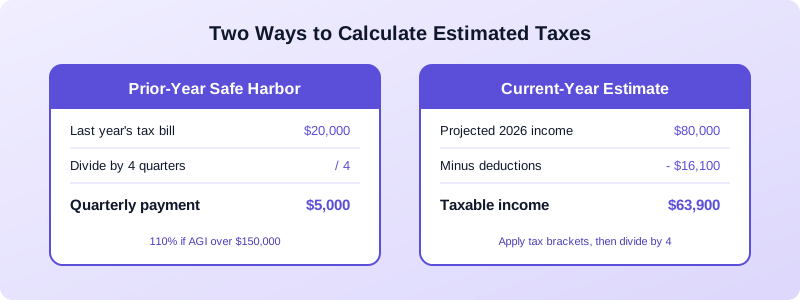
Calculating quarterly tax payments is the step that worries most freelancers. Fortunately, you have two straightforward methods to choose from.
Method 1: Prior-Year Safe Harbor
This is the simplest approach. Take the total tax you owed last year and divide it by four. Pay that amount each quarter.
For example, if your total tax liability last year was $16,000, you would pay $4,000 per quarter. As long as you pay at least 100% of last year's tax (spread across the four quarters), you will not owe an underpayment penalty — even if you earn significantly more this year.
There is one important exception. If your adjusted gross income last year exceeded $150,000 (or $75,000 if you are married filing separately), you need to pay 110% of last year's tax to qualify for the safe harbor.
Method 2: Current-Year Estimate
If your income has changed significantly from last year, this method may be more accurate. Estimate your total income for 2026, subtract your expected deductions, then calculate your tax using the current brackets and the 15.3% self-employment tax rate. Divide the result by four.
For 2026, the standard deduction is $16,100 for single filers. Self-employment tax applies to the first $176,100 of net self-employment income at 15.3%, with the Medicare portion (2.9%) continuing above that threshold.
The IRS provides Form 1040-ES with a worksheet to help you work through this calculation. Many freelancers start with the prior-year method for simplicity, then adjust in later quarters if income shifts substantially.
If your income fluctuates throughout the year, the IRS allows you to use the annualized income installment method. This means you can pay different amounts each quarter based on income actually earned during that period, rather than four equal payments.
Common Mistakes That Lead to Penalties
The IRS charges an underpayment penalty starting at 0.5% per month on amounts you owe, and interest accrues on top of that until you pay in full. The maximum penalty can reach 25% of the unpaid amount. Here are the mistakes that trigger these penalties most often.
Forgetting a deadline. This is the most common issue. One missed payment can trigger a penalty for that quarter even if you catch up later. Set reminders for every deadline.
Underestimating income. Freelance income often grows faster than expected. If you are having a strong year, adjust your remaining quarterly payments upward rather than waiting until tax time to settle up.
Ignoring self-employment tax. Many new freelancers budget only for income tax and forget the 15.3% self-employment tax. On $60,000 of net income, that is an extra $9,180 before any deductions. Make sure you factor this into your calculations from the start.
Not tracking deductions. Deductions reduce your taxable income, which lowers your quarterly payment amounts. If you are not keeping records of your self-employed tax deductions, you may be overpaying each quarter — or worse, missing deductions at filing time that would have lowered your bill.
Skipping payments during slow quarters. Even if you earn less in one quarter, you usually still owe a payment. The safe harbor rules look at your total annual obligation, not quarter-by-quarter income.
How to Actually Make Your Payments
Once you know how much to pay, submitting the payment is simple. The IRS offers several options:
- IRS Direct Pay (irs.gov/directpay) — free bank transfer, no registration needed
- EFTPS (Electronic Federal Tax Payment System) — requires enrollment but lets you schedule payments in advance
- Credit or debit card — processed through third-party providers, which charge a convenience fee
- Check or money order — mail it with a payment voucher from Form 1040-ES
IRS Direct Pay is the fastest option for freelancers — you can complete a payment in under five minutes. EFTPS is ideal if you prefer to schedule all four payments at the beginning of the year.
Do not forget about state estimated taxes. Most states with an income tax also require quarterly payments. Check your state's revenue department for deadlines, as they sometimes differ from the federal schedule.
Building a System That Keeps You On Track
Staying current on quarterly tax payments comes down to three habits: track your income consistently, set money aside as you earn it, and pay on time.
Open a dedicated tax savings account. Every time you receive a client payment, transfer 25% to 30% into a separate account reserved for taxes. This percentage covers both income tax and self-employment tax for most freelancers. When a quarterly deadline arrives, the money is already there.
Track every invoice and expense. Accurate records make your quarterly calculations easier and ensure you claim every deduction you deserve. Good cash flow management starts with knowing exactly what comes in and what goes out. An app like Invoices Customers keeps all your invoices organized in one place, so you always know your income totals when it is time to calculate a payment.
Review and adjust each quarter. Do not just set your payments at the beginning of the year and forget about them. If your income increases or decreases significantly, recalculate. You can adjust future quarterly payments up or down to stay accurate.
Pair invoicing with tax planning. When you invoice as a freelancer, you create a clear record of every dollar earned. That same record becomes the foundation of your tax calculation. Invoices Customers makes it easy to generate professional invoices and track payment status, giving you a running total of your income at any time throughout the year.
Take the Stress Out of Quarterly Taxes
Freelancer quarterly tax payments do not have to be overwhelming. The system is predictable: four deadlines, two calculation methods, and a handful of payment options. Once you build the habit of setting aside money with each payment you receive, quarterly taxes become just another routine part of running your business.
Start with the prior-year safe harbor method, mark all four deadlines in your calendar, and open a separate savings account for tax money. Keep your invoicing organized so you always have an accurate picture of your income.
Ready to get your invoicing organized? Download Invoices Customers and start creating professional invoices in seconds — no sign-up required, no data collection, and it works offline. When tax time comes, you will have a clear record of every dollar earned.
