
Self-Employed Tax Deductions Checklist for 2026

Missing a single tax deduction can cost you hundreds of dollars — and most self-employed workers leave money on the table every year. If you work for yourself, a self-employed tax deductions checklist is one of the most valuable tools you can have during tax season. The average freelancer qualifies for $5,000 to $20,000 in deductions annually, yet many claim only a fraction of what they're owed.
This guide gives you a complete, organized checklist of deductions you can claim as a self-employed professional. Bookmark it, print it, and reference it every time you file.
How Self-Employment Tax Deductions Work
When you work for yourself, you pay both the employer and employee portions of Social Security and Medicare taxes — that's 15.3% on top of your income tax. Deductions reduce your taxable income, which lowers both your income tax and your self-employment tax bill.
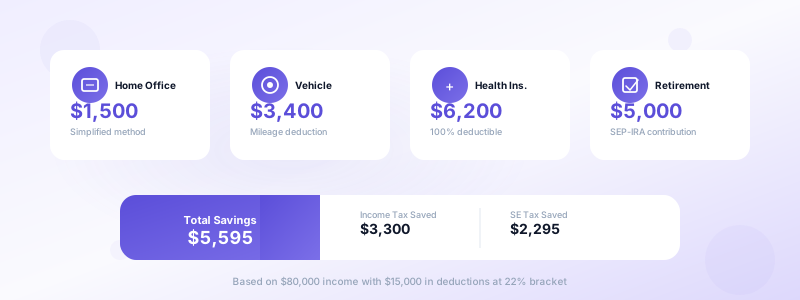
Here's a quick example. If you earn $80,000 and claim $15,000 in deductions, you only pay taxes on $65,000. At a 22% tax bracket, that saves you $3,300 in income tax alone — plus another $2,295 in self-employment tax. That's $5,595 back in your pocket.
To claim deductions, expenses must be "ordinary and necessary" for your business. You need records to back them up, which is why tracking your invoices and expenses throughout the year matters so much. Good cash flow management starts with knowing exactly where your money goes.
Your Complete Self-Employed Tax Deductions Checklist
Use this checklist to make sure you capture every deduction. Check off each one that applies to your business.
Home Office Deduction
- Dedicated workspace: You can deduct $5 per square foot, up to 300 square feet ($1,500 max) using the simplified method
- Actual expenses method: Deduct the percentage of your home used for business — rent, mortgage interest, utilities, insurance, and repairs
- Internet and phone: Deduct the business-use percentage of your monthly bills (if you use your internet 70% for work, deduct 70%)
Vehicle and Travel Expenses
- Standard mileage rate: 70 cents per mile for business driving in 2026
- Actual vehicle expenses: Gas, insurance, repairs, and depreciation based on business-use percentage
- Parking and tolls: Fully deductible for business trips
- Business travel: Airfare, hotels, meals (50% deductible), and transportation for work-related trips
- Per diem rates: Use IRS per diem rates instead of tracking individual receipts when traveling
Professional Services and Tools
- Accounting and tax prep: Fees paid to your accountant, bookkeeper, or tax software subscriptions
- Legal fees: Attorney costs for contracts, business formation, or disputes
- Business software: Invoicing apps, project management tools, design software, and cloud storage
- Professional development: Courses, workshops, certifications, and books directly related to your work
Marketing and Client Acquisition
- Website costs: Domain registration, hosting, and design fees
- Advertising: Google Ads, social media ads, print materials, and business cards
- Networking: Industry conference tickets and association membership fees
- Client meals: 50% of meal costs when meeting with clients or prospects
Insurance and Retirement
- Health insurance premiums: 100% deductible for self-employed individuals (one of the biggest deductions available)
- Retirement contributions: SEP-IRA (up to 25% of net earnings), Solo 401(k) (up to $23,500 employee contribution + employer match)
- Business insurance: General liability, professional liability (E&O), and business property insurance
- Disability insurance: Premiums for policies that protect your income
Office Supplies and Equipment
- Supplies: Paper, ink, postage, and everyday office materials
- Equipment: Computers, monitors, desks, chairs, and printers (Section 179 lets you deduct the full cost in year one, up to $1,250,000)
- Phone and tablet: Business-use percentage of your device and monthly plan
- Shipping costs: Postage and delivery fees for client work

Deductions Most Freelancers Miss
Some of the most valuable deductions are the ones people overlook. Pay special attention to these.
Self-employment tax deduction. You can deduct 50% of your self-employment tax from your income. On $80,000 of net earnings, that's roughly $5,652 in SE tax — meaning a $2,826 deduction. This one is automatic on your return, but many freelancers don't realize it exists.
Qualified Business Income (QBI) deduction. If your taxable income is under $191,950 (single) or $383,900 (married filing jointly), you may deduct up to 20% of your qualified business income. On $65,000 of net income, that's a $13,000 deduction.
Startup costs. If you launched your business this year, you can deduct up to $5,000 in startup expenses immediately, including market research, advertising before launch, and training.
Bank fees and interest. Business checking account fees, credit card interest on business purchases, and merchant processing fees are all deductible. If you use Invoices Customers to create and track your invoices, the records you build make it easy to match payments to business expenses at tax time.
How to Track Deductions Year-Round
Scrambling to find receipts in April is a recipe for missed deductions. Set up a system that runs on autopilot.
Separate your finances. Open a dedicated business bank account and credit card. This creates a clean paper trail and makes it simple to total your deductible expenses at year end.
Record expenses weekly. Spend 15 minutes each Friday logging your business expenses. Categorize them using the checklist above. Waiting until tax season means you'll forget purchases and lose receipts.
Keep your invoices organized. Your invoices are more than payment requests — they're a record of your business income. When you invoice as a freelancer consistently using a tool like Invoices Customers, you build an income trail that matches your bank deposits. That makes filing faster and gives you backup if you're ever audited.
Save 25-30% for taxes. Based on your estimated deductions and tax bracket, set aside a percentage of every payment you receive. A freelancer earning $75,000 with $15,000 in deductions might owe roughly $16,000 in combined income and self-employment tax — that's about 21% of gross income.
File quarterly estimated taxes. The IRS expects quarterly payments if you'll owe more than $1,000 in taxes. Due dates are April 15, June 15, September 15, and January 15. Missing these triggers penalties and interest.
Put Your Checklist to Work
Tax deductions aren't a bonus — they're money you've already earned. Every deduction you miss is cash you're giving away. Print this self-employed tax deductions checklist, tape it near your desk, and review it each quarter as you prepare your estimated payments.
Start by organizing your income records. Use a freelance invoice template to keep your billing consistent, and build the habit of tracking expenses alongside your invoicing. With Invoices Customers, you can create professional invoices in seconds and keep your client records organized — giving you a clear picture of your business income all year long.
The freelancers who pay the least in taxes aren't the ones who earn the least. They're the ones who track everything, claim every deduction they qualify for, and stay organized from January through December.
