
Graphic Design Invoice: What to Charge and How to Bill
A graphic design invoice does two jobs: it requests payment and it documents what the client is actually getting. For designers, that second job is critical. Without clear scope, revision limits, and usage rights in writing, clients assume they're buying unlimited revisions and perpetual commercial rights for every piece of work. Your invoice is where you define the boundaries.
This guide covers what to include, how to price common design projects, and how to structure invoices that get paid without disputes.
What to Include on a Graphic Design Invoice
Your name or studio name and contact info: Professional header with your name, email, and optionally your website. Designers benefit from branding their invoices — consistent typography and colors reinforce that you take design seriously even in administrative documents.
Client details: Company name, contact person, and billing email. Large companies route invoices through accounts payable; confirm who should receive it before your first invoice.
Invoice number and dates: Sequential number, issue date, and payment due date. Net 14 is standard for most freelance design work.
Project name: "Logo Design — Acme Coffee Roasters" makes the invoice immediately identifiable in both your records and the client's.
Itemized deliverables: Each deliverable as a separate line item with description, quantity (hours or flat rate), and amount.
Revision policy: State what's included — "Includes 2 revision rounds. Additional revisions billed at $85/hr." This belongs on the invoice even if it's also in your contract.
Usage rights / licensing: Who can use the work, for how long, and for what purposes. More on this below.
Payment instructions: Your preferred method — bank transfer, PayPal, Venmo, Stripe invoice link — and any relevant account details.
What to Charge: Typical Rates and Project Prices
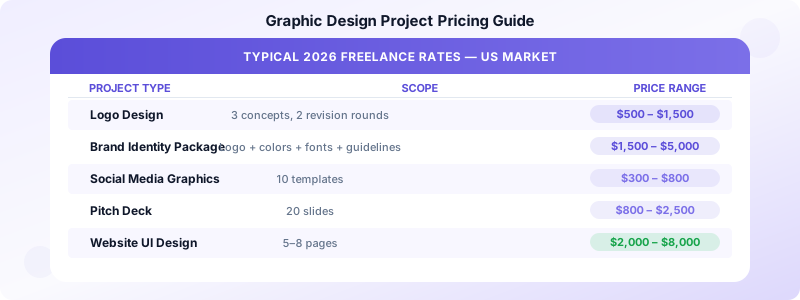
Design pricing varies widely by experience and market, but these ranges reflect typical 2026 freelance rates for US-based designers:
Hourly rates:
- Junior designer (0–3 years): $35–$65/hr
- Mid-level designer (3–7 years): $65–$110/hr
- Senior designer (7+ years): $110–$175/hr
Common project flat fees:
- Logo design (3 concepts, 2 revision rounds): $500–$1,500
- Brand identity package (logo + colors + fonts + guidelines): $1,500–$5,000
- Social media graphic set (10 templates): $300–$800
- Pitch deck (20 slides): $800–$2,500
- Website UI design (5–8 pages): $2,000–$8,000
When billing by project, define the scope precisely: number of concepts, revision rounds, file formats delivered, and timeline. Vague scope leads to scope creep, which leads to unpaid overruns.
Handling Revisions on Your Invoice
Revision scope is the most common source of designer-client disputes. The fix is simple: define it before the project starts and reference it on every invoice.
Standard approach: Include a set number of revision rounds in the flat fee. "2 revision rounds included" is clear. A "revision round" means a consolidated set of changes communicated at once — not a stream of individual requests.
Additional revisions: When a client exceeds the included rounds, bill the extra work as a line item: "Revision round 3 (additional, per agreement): 1.5 hrs × $90 = $135."
Change orders: If the client requests scope changes mid-project (new sizes, additional versions, changed brief), invoice these separately: "Change order: additional social media size variations (12 files) — $240."
The goal isn't to be rigid — it's to make the cost of changes visible so clients make considered decisions about what they actually need.
Licensing and Usage Rights
This is where many designers undercharge — and where the largest invoicing misunderstandings happen. When a client pays for a logo or design, they're licensing your creative work, not buying it outright (unless you've explicitly transferred copyright).
Common usage categories:
- Personal use: The client uses the design privately, not commercially
- Commercial use: The design appears in advertising, products, or revenue-generating contexts
- Exclusive rights: The client is the only one who can use the design
- Work for hire: Full copyright transfer to the client
Each category carries different value. A logo used only on a local café's signage is worth less in licensing terms than the same logo used in national advertising. Many designers charge a base design fee plus a usage licensing fee.
Put it on the invoice: "Usage rights: commercial use, website and print, non-exclusive, perpetual. For broadcast/national advertising rights, contact for licensing quote."
This protects you and educates the client. Most clients have never thought about licensing — your invoice is where they learn.
Invoices Customers lets you add custom notes and line items to every invoice, making it easy to include licensing language and revision terms directly in your client-facing PDF. For guidance on structuring deposits and payment milestones, see our guide on how to create professional invoices.
Deposits for Design Projects
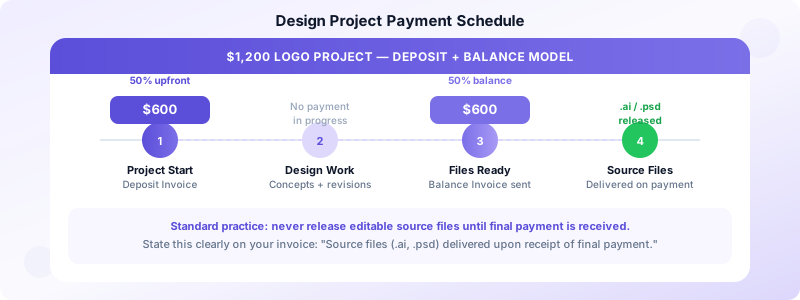
For any project over $500, take a deposit. The standard is 25–50% upfront, with the balance due on delivery.
Invoice your deposit separately or as part of the project invoice with a clear breakdown:
- "Logo design project total: $1,200"
- "50% deposit due at project start: $600"
- "Balance due on final file delivery: $600"
Don't deliver final files — especially editable source files — until the balance is paid. This is standard practice and clients expect it. State it in your invoice: "Source files (.ai, .psd) delivered upon receipt of final payment."
Getting Paid Faster as a Freelance Designer
Send the invoice the day you deliver the work. Not a day later, not at the end of the week. Clients are most engaged with your invoice when your deliverables are fresh in front of them.
Net 14 beats Net 30 for freelancers. Unless your client specifically requests Net 30 due to their AP cycle, default to 14 days. Most small businesses and startups can pay within 14 days; giving 30 just means waiting longer.
Follow up on day 15 if unpaid. A single friendly email — "Just checking in on invoice INV-2026-042 due yesterday" — resolves most late payments instantly.
Don't release additional work until outstanding invoices are settled. If a client has an overdue invoice and wants to start a new project, address the outstanding balance first.
For more on following up on unpaid invoices, see our post on how to follow up on unpaid invoices.
Download Invoices Customers to create clean, professional design invoices with custom line items, usage rights notes, and revision terms — no account needed, all data on your device.
