
How to Collect Unpaid Invoices Before Year End
December has a built-in advantage for collecting overdue invoices: clients are closing their own books and actively processing outstanding payables. A payment that sat ignored in October is more likely to move in November and December than any other time of year. Use that window.
This guide covers how to systematically pursue every outstanding invoice before December 31 — from the mildly late to the seriously overdue.
Why Year-End Is Your Best Collection Window
Three things work in your favor in Q4:
Clients close their books. Finance departments and business owners reconcile accounts in November–December. They're actively looking at what's owed and clearing it. An invoice that has been sitting unpaid for 60 days is more likely to get processed now than in the middle of a busy summer quarter.
Budget use-it-or-lose-it pressure. Many businesses operate on annual budgets. Outstanding invoices represent approved budget that expires December 31. Accounts payable teams are motivated to process them before year-end.
Tax deduction timing. Business clients can deduct your invoice as an expense in the year it's paid. A payment made December 31 vs. January 2 means a tax deduction this year vs. next year. That's real money for many clients.
Use these facts when following up. They give your collection messages a rationale beyond "please pay me."
Step 1: Pull Your Full Outstanding Invoice List
Before reaching out to anyone, compile a complete list of every unpaid invoice:
- Invoice number
- Client name
- Amount
- Invoice date
- Original due date
- Days overdue
Sort by days overdue — oldest first. This is your collection priority list. Then segment into three groups:
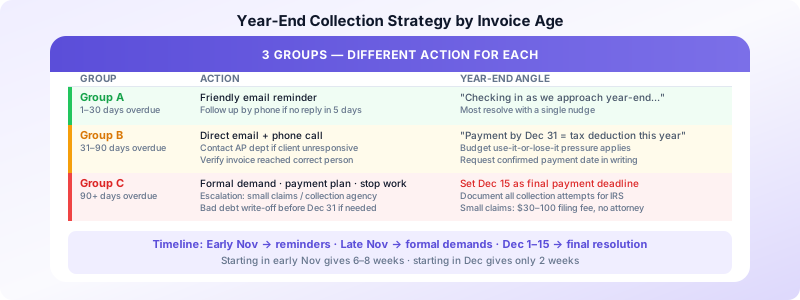
Group A (1–30 days overdue): Likely just delayed, not delinquent. A polite reminder usually resolves these.
Group B (31–90 days overdue): Needs more active follow-up. Some of these clients may have cash flow issues or internal approval delays.
Group C (90+ days overdue): Serious collection challenge. Requires a different approach — direct contact, escalation, or a decision about whether to pursue further.
Step 2: Group A — Friendly Reminder Campaign
For invoices 1–30 days overdue, send a brief, professional email:
Subject: Invoice #[number] — friendly reminder
Hi [Name], just a quick follow-up on invoice #[number] for $[amount], which was due on [date]. Could you let me know the expected payment date? If you have any questions about the invoice, I'm happy to help. Thanks!
Send this to every Group A client in the first week of November. The tone is friendly and assumes good faith — most late payments in this range are administrative, not intentional.
Follow up by phone if no response within 5 business days. A brief, warm phone call often resolves what emails don't.
Step 3: Group B — Direct Follow-Up with Year-End Framing
For invoices 31–90 days overdue, you need a more direct approach. Use the year-end context:
Subject: Invoice #[number] — year-end payment request
Hi [Name], I'm following up on invoice #[number] for $[amount], now [X] days overdue. As we're approaching year-end, I wanted to check in directly — are there any issues I can help resolve? If it's helpful, payment before December 31 allows you to record this expense in the current tax year. Please let me know a confirmed payment date so I can plan accordingly.
The year-end framing is factually accurate and gives the client a reason to act now rather than defer.
If you haven't heard back within 3 business days, call. Get the accounts payable contact if the main client isn't responsive. AP departments often hold invoices that the client-side contact doesn't know are stuck.
Also check: Did you send the invoice to the right email address? Is it the correct amount? Are there any disputed line items? Resolving these questions now eliminates the most common reasons for legitimate non-payment.
Step 4: Group C — Serious Overdue (90+ Days)
Invoices over 90 days overdue need an escalated approach:
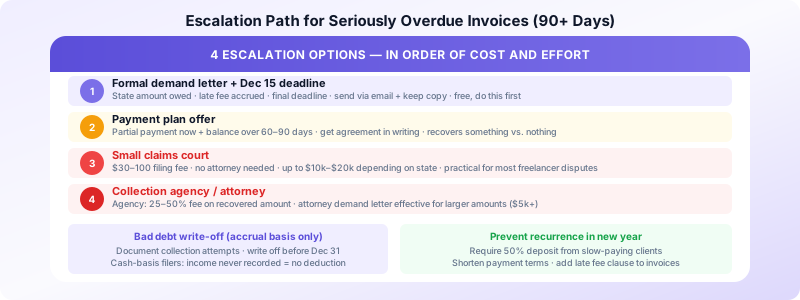
Formal written notice. A formal demand letter stating the amount owed, the original due date, your late fee calculation (if applicable), and a final payment deadline (e.g., December 15). Send via email with read receipt and keep a copy.
Payment plan offer. If the client has genuine cash flow issues, a payment plan is better than no payment. Offer to accept a partial payment now and the balance over 60–90 days. Get the agreement in writing.
Consider stopping work. If you're still providing services to this client, stop until the outstanding invoice is resolved. Continuing to work for a non-paying client increases your exposure and signals that non-payment has no consequences.
Evaluate escalation options:
- Small claims court (up to $10,000–$20,000 depending on state, no attorney needed)
- Debt collection agency (typically 25–50% fee, but recovers something)
- Attorney demand letter (effective for larger amounts)
For most freelancers, small claims court is the practical escalation path for invoices in the $1,000–$10,000 range. Filing is straightforward and the filing fee is $30–$100.
Bad debt decision. If you use accrual-basis accounting and determine the debt is genuinely uncollectible, write it off before December 31 to claim the bad debt deduction. Document your collection attempts.
Step 5: Document Every Contact Attempt
For every overdue invoice, keep a log:
- Date of each contact attempt
- Method (email, phone, letter)
- Response received (or no response)
- Commitments made
This documentation matters for two reasons: if you escalate to collections or court, you need evidence of your collection attempts. And if you write off bad debt, the IRS wants documentation that you made genuine efforts to collect.
Screenshot sent emails. Save voicemail confirmations. Keep copies of all written notices.
Step 6: Adjust Terms for the New Year
After your year-end collection push, review what you learned:
- Which clients paid late consistently? Require deposits from them going forward.
- Which payment terms led to the most delays? Shorten them.
- Are your invoices reaching the right people? Verify billing contacts.
- Do you have a late fee policy on your invoices? Add one if not.
Prevention is more effective than collection. For a complete approach to avoiding late payments in the first place, see our guide on following up on unpaid invoices.
Your Year-End Collection Timeline
To maximize what you collect before December 31:
- Early November: Send Group A reminders + Group B direct follow-up
- Mid November: Follow up with non-responders by phone
- Late November: Send Group C formal demand letters with Dec 15 deadline
- December 1–15: Final collection window — resolve payment plans, accept partial payments
- December 15–20: Final decision on write-offs and escalation
- December 31: Close books — all written-off bad debt documented
Starting in early November gives you six to eight weeks of active collection time. Starting in December gives you two weeks. The earlier you begin, the more you'll recover.
Invoices Customers keeps your invoice status visible at a glance — see exactly what's paid, pending, and overdue so you can run this process directly from your iPhone without digging through spreadsheets. For the full record-keeping system that supports year-end collections, see our invoice record keeping best practices.
Sources:
