
Invoice vs Bill vs Statement: Key Differences
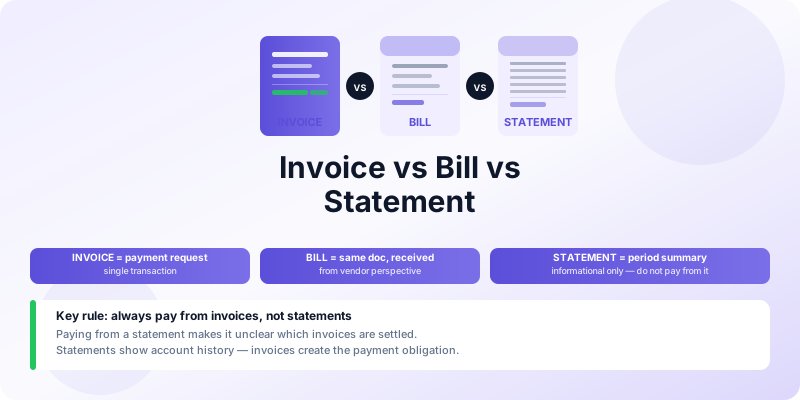
The words invoice, bill, and statement are used so interchangeably in everyday business conversation that most people assume they mean the same thing. They do not. Each document serves a different purpose, carries different legal weight, and fits a different point in the payment cycle.
Getting them right keeps your records clean, reduces confusion with clients, and prevents accounting errors. Here is exactly what each one is and when to use it.
What Is an Invoice?
An invoice is a formal payment request that you send to a client after delivering goods or services. It documents a single transaction: what was delivered, the agreed price, and when payment is due.
A proper invoice includes:
- Your business name and contact details
- Client name and billing address
- Invoice number and issue date
- Itemized list of services or goods delivered
- Total amount due
- Payment terms (e.g., Net 30, due on receipt)
- Payment methods accepted
The invoice is the primary document that creates a legal payment obligation. When a client receives an invoice, they owe you money. When you receive one from a vendor, you owe them money.
Invoices live in your accounts receivable (money owed to you) and your clients' accounts payable (money they owe others).
What Is a Bill?
A bill is simply an invoice viewed from the other side of the transaction. When you send a client an invoice, that same document is their bill. The terminology shifts based on perspective:
- You issue an invoice.
- Your client receives a bill.
In everyday usage, "bill" also describes recurring charges — utility bills, phone bills, subscription bills. These are typically simpler documents than formal invoices: they show the charge, the period covered, and the due date, but may not include the detailed itemization that an invoice does.
The key point: invoice and bill refer to the same underlying document. The word used depends on whether you are the sender (invoice) or the recipient (bill). For accounting purposes, treat them identically.
What Is a Statement?
A statement — sometimes called an account statement or billing statement — is a summary document. Instead of recording a single transaction, it shows all activity in a client's account over a defined period (typically a month).
A standard account statement includes:
- Opening balance at the start of the period
- All invoices issued during the period (with invoice numbers and dates)
- All payments received during the period
- Any credits or adjustments applied
- Closing balance (total outstanding amount)
The critical difference: statements are informational, not payment requests. A client should always pay from invoices, not from statements. Paying from a statement risks double payments or unclear application of funds.
Statements serve three main purposes:
Account reconciliation. The client can compare your statement against their own records to verify all invoices are accounted for and all payments have been applied.
Collections. Sending a statement to a client with multiple overdue invoices gives them a consolidated view of what they owe. It is less aggressive than sending five individual reminder emails.
Relationship maintenance. A monthly statement shows clients you are organized and makes it easy for their accounts payable team to match your invoices.
Side-by-Side Comparison
| Feature | Invoice | Bill | Statement | |---|---|---|---| | What it covers | Single transaction | Single transaction | Multiple transactions | | Direction | You → client | Vendor → you | You → client | | Purpose | Request payment | Notify of amount owed | Summarize account activity | | Legal obligation | Creates payment obligation | Creates payment obligation | Informational only | | Pay from it? | Yes | Yes | No — pay from invoices | | Typical timing | After delivery | On billing cycle | Monthly or periodic |
When Clients Should Pay From Invoices, Not Statements
This distinction matters practically. If a client receives a statement showing $4,500 outstanding across three invoices and writes one check for $4,500, it can be unclear in your records how that payment applies. Does it pay invoices 1, 2, and 3 in full? Does it partially pay invoice 3?
When clients pay per invoice, each payment references a specific invoice number. Your records stay clean. Reconciliation is simple. Disputes are easy to trace.
On your statements, note clearly: "This statement is for reference only. Please pay from individual invoices." Some accounting systems add this automatically.
When to Send Each Document
Send an invoice immediately after completing work or delivering goods. For large projects, send milestone invoices as each phase completes. For recurring services, send on a regular billing schedule (monthly, weekly). See what to include on an invoice for the full required fields list.
Send a statement when:
- A client has multiple open invoices and you want to give them a consolidated view
- You do end-of-month reconciliation with ongoing clients
- A client is overdue and you want to show them the full picture of what is owed
- A client's accounts payable team requests one for their records
Receive bills from your vendors and treat them as invoices in your accounts payable. Record them in your expense records on the date received, not the date paid (for accrual-basis businesses) or on the date paid (for cash-basis businesses).
Common Confusion Points
"My client calls it a bill but I call it an invoice — are we talking about different documents?" No. Same document, different terminology. Perspective determines the word.
"Do I need to send both invoices and statements?" Not always. For one-off projects, an invoice is sufficient. Statements add value for clients with multiple ongoing transactions where periodic reconciliation helps both parties.
"Can a statement create a legal obligation to pay?" Typically no. A statement reflects activity that was already documented on individual invoices. The payment obligation comes from the invoice. However, if a statement is the only documentation of a charge — which it should not be — it may have some evidentiary weight in a dispute, but it is not best practice to rely on statements as the primary payment document.
"What about credit card statements or bank statements?" These are a different type of statement — they show transactions in a financial account rather than in a billing relationship with a client. The same principle applies: they are summaries, not payment requests.
Practical Setup for Freelancers and Small Businesses
Most freelancers and small businesses only need invoices day-to-day. Add statements to your workflow if:
- You have five or more ongoing clients with monthly billing
- Clients request them for their own records
- You are trying to collect on multiple overdue invoices from the same client
For invoice record keeping that covers both documents, see invoice record keeping best practices.
Your invoicing app should handle both automatically. A good system lets you create per-invoice payment requests and generate period statements from those same records with one click. The Invoices Customers app for iPhone makes it straightforward to create and send invoices from anywhere, keeping your transaction records organized for whenever you need to pull a summary.
Quick Reference
- Invoice = payment request for a single transaction (you send it)
- Bill = the same document, received from someone else
- Statement = a periodic summary of all transactions in an account (informational, not a payment request)
Always send invoices to request payment. Use statements to show clients their account history or to help collect on multiple overdue balances. Keep them separate in your records so your accounts receivable stays accurate.
