
How to Price Freelance Services Profitably
Setting the right price for your work is one of the hardest decisions you'll face as a freelancer. Price too low and you burn out chasing volume. Price too high without justification and clients walk away. Knowing how to price freelance services correctly means the difference between a sustainable business and one that quietly drains your savings account.
The good news: pricing isn't guesswork. You can use concrete formulas, market data, and positioning strategies to land on rates that attract clients and keep you profitable. This guide breaks down five approaches to pricing your freelance services, with real numbers you can adapt to your situation.
Start With Your Minimum Viable Rate
Before exploring pricing models, you need one number: your floor rate. This is the absolute minimum you can charge and still cover your costs.
Here's the formula. Add up your annual expenses: rent, insurance, software, taxes (set aside 25-30%), retirement savings, and the income you need to live. Divide that total by your billable hours per year.
Most freelancers can bill about 1,000-1,200 hours annually. The rest goes to marketing, admin, and downtime. If you need $75,000 per year after expenses and you bill 1,100 hours, your floor rate is $68/hour. Never go below this number.
This floor rate isn't your actual rate. It's your walk-away point. Every pricing model you choose should put you above this baseline.
Hourly Pricing: Simple but Limited
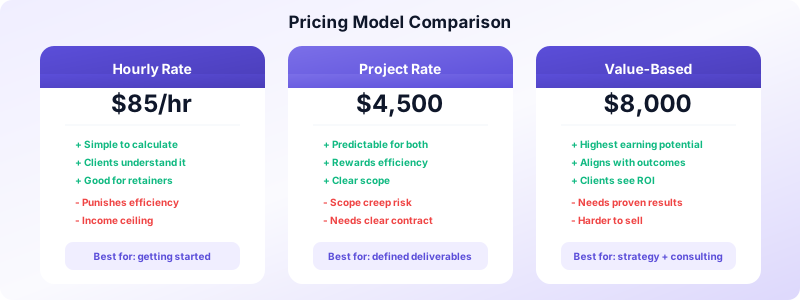
Hourly billing is where most freelancers start. You track your time and bill clients for every hour worked. It's straightforward, and clients understand it immediately.
When hourly works well. Ongoing retainer work, tasks with unpredictable scope, and early-stage freelancing when you're still learning how long projects take.
Real example. A freelance graphic designer charges $85/hour. A logo project takes 12 hours, so the client pays $1,020. If revisions push it to 18 hours, the bill becomes $1,530.
The downside. Hourly pricing punishes efficiency. As you get faster, you earn less per project for the same quality of work. It also creates friction — clients watch the clock, and every email becomes a billable-or-not decision.
If you use hourly pricing, track your time carefully and review your effective hourly rate quarterly. You may find that certain project types consistently earn you more per hour than others.
Project-Based Pricing: Predictability for Both Sides
Project pricing means quoting a flat fee for a defined scope of work. The client knows exactly what they'll pay, and you know exactly what you'll deliver.
When project pricing works well. Repeatable deliverables like websites, brand identities, copywriting packages, or app development with clear requirements.
Real example. A freelance web developer quotes $4,500 for a 5-page business website. The project takes 40 hours, giving an effective rate of $112.50/hour. If the developer completes it in 30 hours through efficient workflows, the effective rate jumps to $150/hour.
How to set project prices. Estimate the hours, multiply by your target hourly rate, then add a 15-20% buffer for scope creep and revisions. A project you estimate at 40 hours with a $100/hour target becomes $4,000 base + $800 buffer = $4,800.
The key to project pricing is a detailed scope document. List every deliverable, the number of revision rounds, and what counts as out-of-scope. Without clear boundaries, flat fees become a trap. When you send the final freelance invoice, the client should see exactly what they agreed to pay for.
Value-Based Pricing: Charge What It's Worth
Value-based pricing ties your fee to the outcome your work produces, not the time it takes. This is the most profitable approach, but it requires confidence and strong positioning.
The core idea. If your marketing strategy generates $200,000 in new revenue for a client, charging $15,000 for that strategy is a bargain — even if it only took you 30 hours to create.
When value pricing works well. Consulting, strategy, marketing, and any service where you can tie your work to measurable business results like revenue, cost savings, or time saved.
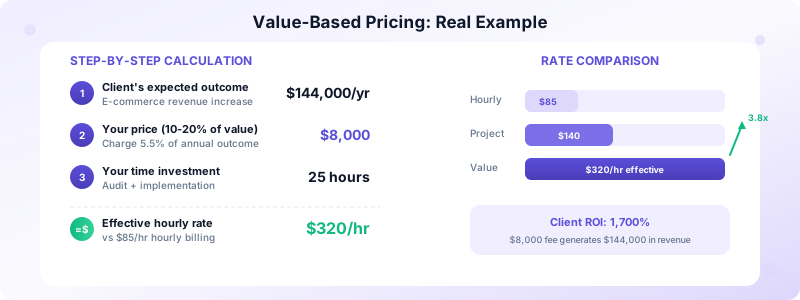
Real example. A freelance conversion rate optimizer charges $8,000 for an e-commerce audit and implementation. The client's monthly revenue increases by $12,000. The freelancer spent 25 hours on the project, earning an effective rate of $320/hour. The client earned a 150% return in month one alone.
How to calculate value prices. Ask the client what a successful outcome is worth. Then price your services at 10-20% of that expected value. If solving a problem saves the client $50,000/year, a $5,000-$10,000 fee feels reasonable to both sides.
Value pricing requires strong cash flow management because projects may be fewer but higher-value. Make sure you have reserves to handle gaps between large engagements.
Tiered and Packaged Pricing: Let Clients Choose
Packaging your services into tiers gives clients options while anchoring their perception of value. Offer three packages — basic, standard, and premium — and most clients pick the middle option.
Real example. A freelance copywriter offers three website copy packages:
- Starter — Home page + About page: $1,200
- Growth — Starter + 3 service pages + SEO: $2,800
- Complete — Growth + blog setup (4 posts) + email sequence: $5,500
Most clients choose Growth. The Starter option makes Growth look like great value, and the Complete package captures clients who want everything handled.
Why tiered pricing works. It eliminates the awkward negotiation phase. Clients self-select based on their budget and needs. You also increase your average project value because the anchor of the premium package makes mid-tier pricing feel affordable.
Build your packages around deliverables, not hours. Each tier should have a clear list of what's included so there's no ambiguity when you invoice the client.
How to Raise Your Rates Without Losing Clients
Pricing isn't a one-time decision. You should raise your rates at least once a year. Here's how to do it without damaging client relationships.
Give 30-60 days notice. Send a clear email explaining that your rates will increase on a specific date. Frame it around the value you've delivered, not your costs.
Grandfather existing projects. Honor current pricing for ongoing work and apply new rates to future projects. This shows respect for the relationship.
Back it up with results. If you helped a client increase their revenue by 40%, a 10-15% rate increase is easy to justify. Keep a record of your wins.
Start with new clients. Test higher rates on new prospects first. If they're closing at the same rate, your pricing is still below what the market will pay.
A freelancer who starts at $75/hour and raises rates by 15% annually reaches $131/hour within four years — without changing anything about their skill set except their confidence and client roster.
Turn Your Pricing Into Professional Invoices
Your pricing strategy only works if you capture every dollar you've earned. Create clear, detailed invoices that reflect the value you deliver. Use Invoices Customers to build professional invoices in seconds on your iPhone — add your line items, set payment terms, and send a polished PDF before the client's attention moves on.
Knowing how to price freelance services is the foundation of a profitable business. Pick the model that matches your work, set your floor rate, and review your numbers every quarter. Your rates should grow as your skills and reputation do.
Download Invoices Customers free on the App Store and start invoicing at the rates you deserve.
