
Progress Billing for Construction Projects
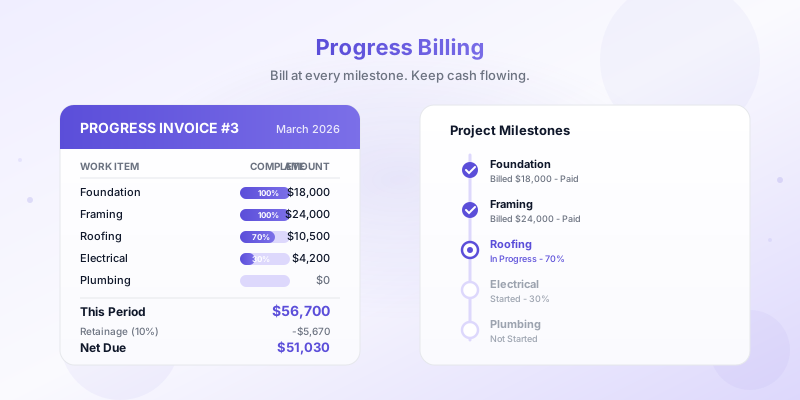
Progress billing for construction projects lets you collect payments at each stage of a job instead of waiting until the very end. If you have ever finished a multi-month build and then chased a single large payment, you already know why this approach matters. Breaking the total contract into smaller invoices tied to milestones keeps your cash flow steady and your client informed throughout the project.
This guide covers how progress billing works, how to structure your milestones, what to include on each invoice, and how to avoid the common mistakes that delay payments.
What Is Progress Billing and Why It Matters
Progress billing is an invoicing method where you bill your client incrementally as you complete defined portions of the work. Instead of one final lump-sum invoice, you send multiple invoices — each tied to a milestone, a percentage of completion, or a set time period.
This matters for two reasons. First, it protects your cash flow. Construction projects require you to pay for labor, materials, and equipment long before the client sees a finished product. Without progress billing, you fund those costs out of pocket for months. Second, it builds trust. Clients see exactly what they are paying for because each invoice corresponds to visible, verifiable work.
Progress billing is standard practice on most commercial and residential jobs that last longer than a few weeks. If you already use construction estimates and bids to win work, adding structured billing milestones is the logical next step.
How to Structure Your Progress Billing Milestones
The way you divide your project into billing stages directly affects how smoothly you get paid. There are three common approaches, and the best one depends on your project type and contract.
Milestone-based billing ties each invoice to a specific project phase. For example, you might bill after completing the foundation, again after framing, again after roofing, and a final invoice at project completion. This approach works well for projects with clearly defined stages.
Percentage-of-completion billing invoices based on the fraction of total work finished. If you have completed 25% of the contracted scope, you bill 25% of the contract value. This method suits projects where stages overlap or progress is more gradual.
Time-based billing sends invoices at regular intervals — often monthly. You document what you completed during that period and bill accordingly. This is common on long-duration commercial projects.
Whichever method you choose, define it in your contract before work starts. Spell out the billing triggers, the documentation each party needs to provide, and the timeline for payment after you submit each invoice.
What to Include on a Progress Billing Invoice
A progress billing invoice needs more detail than a standard one-time invoice. Your client — and often their lender — will review each submission carefully. Missing information causes delays, so get it right the first time.
Every progress invoice should include:
- Your business name, contact information, and license number
- The client's name and project address
- A unique invoice number that follows your contractor invoice numbering system
- The date of the invoice and the billing period it covers
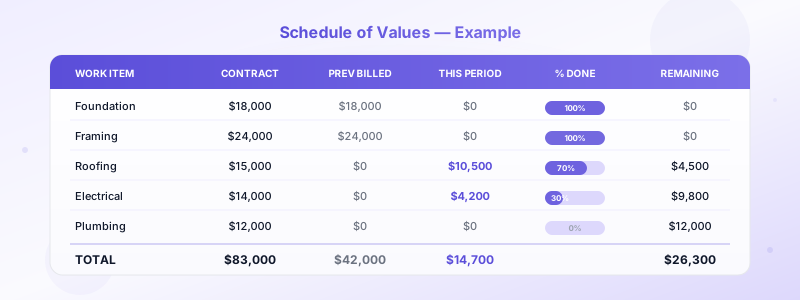
- A schedule of values listing every major work item, its total value, the amount previously billed, the amount billed this period, and the remaining balance
- The retainage amount withheld (if your contract includes retainage)
- Supporting documentation such as photos, inspection reports, or material receipts
- Clear payment terms with a due date
The schedule of values is the backbone of every progress invoice. It gives your client a transparent view of where the project stands financially. Keep it updated with each billing cycle so there are no surprises.
Build a Schedule of Values That Prevents Disputes
Your schedule of values breaks the total contract into line items, each with a dollar value. As you complete work, you fill in the percentage complete for each item. This document travels with every progress invoice and tells the story of the project in numbers.
Here is how to build one that holds up:
Start with your estimate. Pull your line items directly from the construction estimate you used to win the job. This keeps your billing consistent with the numbers the client already approved.
Keep line items specific. Avoid vague entries like "general labor" or "miscellaneous." Break work into categories the client can verify — foundation, framing, electrical rough-in, plumbing rough-in, drywall, painting, and so on.
Do not front-load values. Resist the temptation to assign higher values to early milestones. Clients and their lenders will catch this, and it erodes trust. Assign values that reflect the actual cost of each phase.
Include materials stored on-site. If you have purchased materials that are on-site but not yet installed, you can typically include their value in your progress bill. Document them with photos and receipts.
Using an app like Invoices Customers makes it easier to create structured invoices for each billing stage. You can set up line items, add quantities and prices, and generate a professional PDF to send from your phone right at the job site.
Common Progress Billing Mistakes to Avoid
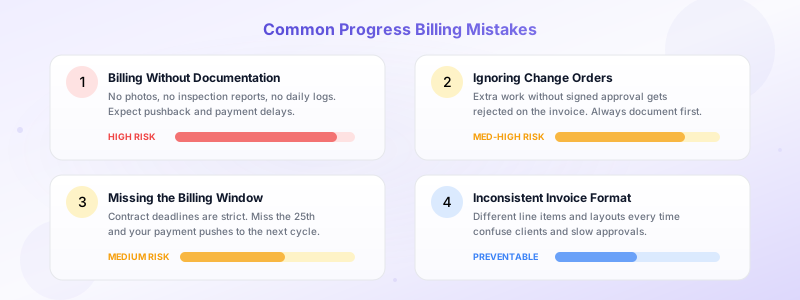
Even experienced contractors run into billing problems. Here are the mistakes that cause the most payment delays.
Billing without documentation. If you submit a progress invoice claiming 60% completion but provide no photos, inspection reports, or daily logs, expect pushback. Always attach evidence of the work you completed.
Ignoring change orders. Scope changes happen on nearly every construction project. If you perform extra work without a signed change order and then include it on your progress invoice, the client may reject the entire submission. Document every change in writing before doing the work.
Missing the billing window. Many contracts specify a submission deadline — often the 25th of the month for monthly billing cycles. Miss that window and your payment gets pushed to the next cycle. Set calendar reminders well in advance.
Letting retainage pile up without a plan. Retainage — typically 5% to 10% of each progress payment — stays with the client until project completion. Track it carefully and know exactly when and how to invoice for its release.
Sending inconsistent invoices. If every progress invoice looks different, uses different line items, or arrives in a different format, you make it harder for the client to approve. Use a consistent template for every billing cycle. Invoices Customers lets you save your line items and reuse them, so every invoice follows the same professional format.
How to Get Progress Payments Approved Faster
Slow approvals drain your cash flow just as badly as late payments. Speed up the process with these practices.
Submit clean, complete invoices. Double-check every number against your schedule of values before you send. One math error can send the entire invoice back for revision.
Communicate before you bill. Give your client or project manager a heads-up a few days before submitting. Walk through the work completed so there are no surprises when the invoice arrives.
Pair your invoice with a site visit. Whenever possible, time your progress invoice submission with a site walkthrough. When the client can see the completed work in person, approval comes faster.
Use a deposit invoice for mobilization costs. Before the first progress payment kicks in, a deposit invoice covers your upfront expenses for equipment, permits, and initial materials. This bridges the cash flow gap at the start of the project.
Send professional invoices every time. A polished, clearly formatted invoice signals that you run a professional operation. Invoices Customers helps you create clean PDFs with all the details your client needs, and you can send them directly from your iPhone — even from the job site. Download Invoices Customers from the App Store and start billing smarter on your next project.
Progress billing protects both you and your client throughout a construction project. Set clear milestones, document your work, submit consistent invoices, and follow up promptly. When you treat progress billing for construction projects as a system rather than an afterthought, you spend less time chasing payments and more time building.
