
Deposit Invoice for Projects: A Practical Guide
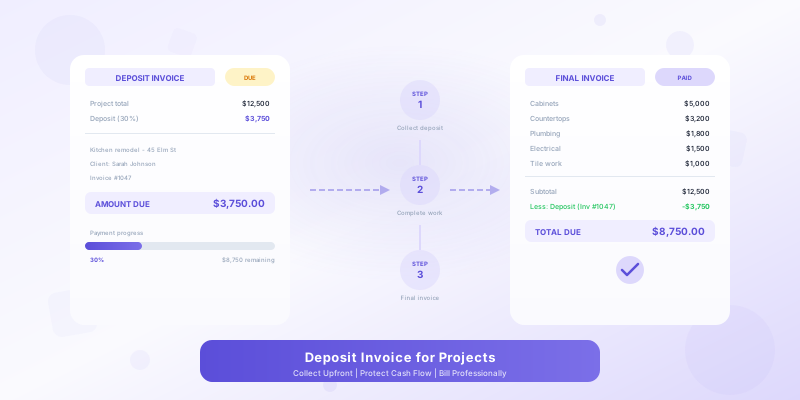
A deposit invoice for projects protects you from doing work you never get paid for. When you take on a large job, collecting partial payment upfront secures your cash flow and signals that the client is serious. Without a deposit, you carry all the financial risk while your client carries none.
This guide walks you through everything you need to know about deposit invoices. You will learn when to request a deposit, how much to charge, what to include on the invoice, and how to handle the final balance once the project wraps up.
What Is a Deposit Invoice?
A deposit invoice is a billing document you send before starting work. It requests partial payment — typically a percentage of the total project cost — as a commitment from the client. Once the client pays the deposit, you begin the project.
Deposit invoices differ from standard invoices in one key way. A regular invoice bills for completed work. A deposit invoice bills for work you have not started yet. Think of it as a financial handshake that locks in the agreement for both sides.
You might also hear deposit invoices called advance invoices, retainer invoices, or upfront payment requests. The concept stays the same regardless of the label: you collect money before delivering the finished product.
Contractors, designers, consultants, and anyone working on multi-week or multi-month projects should use deposit invoices. If you already send construction estimates and bids, adding a deposit invoice to your workflow is a natural next step.
When Should You Request a Deposit?
Not every job needs a deposit invoice. A quick one-hour repair or a small task under a few hundred dollars rarely justifies one. But larger projects almost always do.
Request a deposit when:
- The project total exceeds $1,000
- You need to purchase materials before starting
- The timeline stretches beyond two weeks
- You are working with a new client for the first time
- The project requires you to block out your schedule and turn away other work
Skip the deposit when:
- The job takes less than a day
- You have a long-standing relationship with the client and a history of prompt payment
- The total amount is small enough that non-payment would not hurt your business
The goal is risk management. The bigger the project and the less you know the client, the more important that upfront payment becomes. A solid deposit policy pairs well with clear payment terms on every document you send.
How Much Should You Charge as a Deposit?
Industry norms vary, but most professionals charge between 25% and 50% of the total project cost as a deposit. Here is a breakdown by situation.
| Scenario | Recommended Deposit | Why | |---|---|---| | Small project ($1,000–$3,000) | 50% | Higher risk relative to effort | | Medium project ($3,000–$10,000) | 30–50% | Covers materials and initial labor | | Large project ($10,000+) | 25–30% | Client may resist a large dollar figure | | Material-heavy job | Cost of materials + 20% | Protects you from out-of-pocket losses | | New client, no track record | 50% | Maximum protection for unknown risk |
Keep your deposit percentage consistent across similar project types. Clients respect predictability, and a standard policy removes the awkwardness of negotiating upfront payment on every deal.
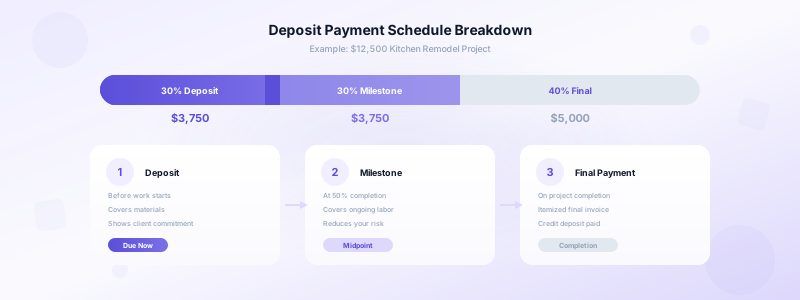
If the project is large enough, consider splitting the remaining balance into milestone payments instead of one final lump sum. You might collect 30% upfront, 30% at the halfway point, and 40% on completion. This steady income stream is essential for managing your cash flow on longer engagements.
What to Include on a Deposit Invoice
A deposit invoice needs every element of a standard invoice plus a few additional details. Missing information creates confusion and gives clients a reason to delay payment.
Standard invoice elements:
- Your business name, address, and contact information
- Client name and billing address
- Unique invoice number and date
- Description of the project
Deposit-specific elements:
- The word "Deposit" or "Advance Payment" in the invoice title or description
- Total project cost clearly stated
- Deposit amount and the percentage it represents
- Remaining balance after the deposit
- Payment due date for the deposit
- Note explaining when work begins relative to deposit receipt
Here is what the line items on a deposit invoice might look like for a kitchen remodel project:
| Description | Amount | |---|---| | Kitchen remodel — total project cost | $12,500.00 | | Deposit due (30%) | $3,750.00 | | Amount due now | $3,750.00 |
Below the line items, add a note: "Remaining balance of $8,750.00 due upon project completion. Work begins within 5 business days of deposit receipt."
This level of clarity prevents misunderstandings. Your client knows exactly what they owe now, what they owe later, and when you will start. For a full breakdown of required invoice elements, check out the guide on what to include on an invoice.
How to Handle the Final Invoice After the Deposit
Once you finish the project, you need to send a final invoice that accounts for the deposit already paid. Getting this wrong leads to overcharging, undercharging, or confusing your client.
Step 1: Reference the original deposit invoice. Include the deposit invoice number and the amount paid on your final invoice. This creates a clear paper trail.
Step 2: Show the full project cost. List all completed work with itemized line items, quantities, and rates — just like you would on any professional invoice.
Step 3: Subtract the deposit. Add a line item that reads "Less: Deposit paid (Invoice #XXX)" with a negative amount equal to the deposit.
Step 4: Show the remaining balance. The total due on your final invoice equals the full project cost minus the deposit.
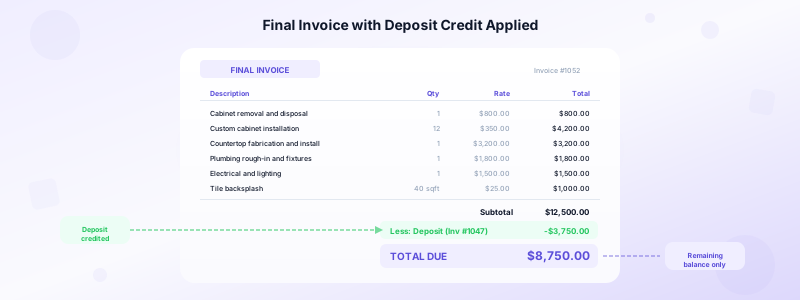
Here is a final invoice example for the same kitchen remodel:
| Description | Qty | Rate | Total | |---|---|---|---| | Cabinet removal and disposal | 1 | $800.00 | $800.00 | | Custom cabinet installation | 12 units | $350.00 | $4,200.00 | | Countertop fabrication and install | 1 | $3,200.00 | $3,200.00 | | Plumbing rough-in and fixture install | 1 | $1,800.00 | $1,800.00 | | Electrical and lighting | 1 | $1,500.00 | $1,500.00 | | Tile backsplash | 40 sq ft | $25.00 | $1,000.00 | | Subtotal | | | $12,500.00 | | Less: Deposit paid (Inv #1047) | | | -$3,750.00 | | Total Due | | | $8,750.00 |
This format makes your billing transparent. The client sees every dollar accounted for and understands exactly why the remaining balance is what it is.
Common Deposit Invoice Mistakes to Avoid
Even experienced professionals make errors with deposit invoices that slow down payment or create disputes. Watch out for these pitfalls.
Not labeling it as a deposit. If your invoice looks like a regular bill, the client might think the deposit amount is the full project cost. Always include "Deposit Invoice" in the title and reference the total project value.
Skipping the written agreement. A deposit invoice alone is not a contract. Pair it with a written agreement or freelance contract that outlines scope, timeline, and payment terms. The deposit invoice then serves as the billing mechanism for what the contract already defines.
Forgetting to credit the deposit on the final invoice. Double-billing your client destroys trust instantly. Always subtract the deposit paid from the final invoice total and reference the original deposit invoice number.
Setting vague payment deadlines. "Due soon" or "Due before work starts" is not specific enough. Use a concrete date or a standard term like Net 7 to give clients a clear deadline.
Charging too little. A 10% deposit on a $15,000 project barely covers your material costs. If the client walks away, you are still out of pocket. Set your deposit high enough to cover your upfront expenses and some of your time.
Create Deposit Invoices Quickly with Invoices Customers
You should not spend more time creating a deposit invoice than the deposit is worth. With Invoices Customers, you can build a professional deposit invoice on your iPhone in under a minute.
Add your client details, enter the deposit amount as a line item, include a note about the total project cost and remaining balance, and send the PDF directly from the app. When the project wraps up, create your final invoice in the same app and reference the original deposit. All your client data and invoice history stay organized in one place — no account required, no internet needed.
A deposit invoice for projects is not just a billing formality. It is a business tool that protects your income, sets professional expectations, and keeps your projects running smoothly from day one. Start using deposit invoices on your next project and download Invoices Customers to make the process effortless.
