
Freelance Contract Template: 6 Must-Have Clauses
A solid freelance contract template essentials checklist can save you from late payments, scope creep, and awkward client disputes. If you freelance without a contract, you rely entirely on trust — and trust does not pay your bills when a project goes sideways.
Nearly 71% of freelancers report having a client refuse to pay or delay payment at some point. A well-written contract gives you legal backing and sets clear expectations from day one. This guide covers the exact clauses your freelance contract needs, why each one matters, and how to put them into practice right now.
Why Every Freelancer Needs a Written Contract
Verbal agreements feel convenient, but they fall apart fast. When a client says "just add this small feature," a verbal agreement gives you zero leverage to negotiate extra pay. A written contract changes everything.
Contracts protect your income. If a client refuses to pay after delivery, a signed contract is your primary evidence in any dispute. Without one, you have little more than an email thread and hope.
Contracts prevent scope creep. When the project scope is written down, any request outside that scope becomes a clear change order — not an assumed freebie. You can point to the document and renegotiate fairly.
Contracts build professionalism. Clients take you more seriously when you present a professional agreement. It signals that you run a real business, not a side hustle.
Contracts reduce awkward conversations. Payment terms, revision limits, deadlines — everything is settled upfront. When disagreements happen, both sides refer to the contract instead of arguing about who said what.
Scope of Work: Define Exactly What You Deliver
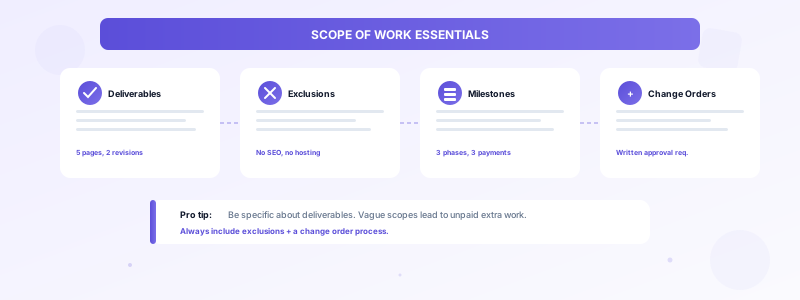
The scope of work clause is the most important section of your freelance contract. Vague scopes lead to vague expectations, and vague expectations lead to unpaid extra work.
Be specific about deliverables. Instead of "website design," write "Design and develop a 5-page responsive website (Home, About, Services, Portfolio, Contact) with up to 2 rounds of design revisions." Specificity eliminates ambiguity.
List what is excluded. State what falls outside the project scope. For example: "This project does not include ongoing maintenance, SEO optimization, or content writing." Exclusions protect you from assumptions.
Define milestones for larger projects. Break a $10,000 project into phases with clear deliverables for each. Phase 1 might be wireframes, Phase 2 design mockups, Phase 3 development. Each milestone triggers a payment and a client approval step.
Include a change order process. State that any work outside the defined scope requires a written change order with a separate cost estimate. This single clause can save you thousands of dollars a year.
Payment Terms That Protect Your Cash Flow
Your contract must spell out exactly how, when, and how much the client pays. Unclear payment terms are the number one cause of late freelance payments.
State the total project fee. Whether you charge hourly or per project, the contract should include the total estimated cost or hourly rate and estimated hours.
Require a deposit. For projects over $1,000, a 25-50% deposit before work begins is standard. Write it into the contract: "A 50% deposit of $2,500 is due before work commences. Remaining balance is due upon project completion."
Set clear due dates. Use specific payment terms like Net 15 or Due on Receipt. Avoid vague language like "payment due upon completion" — define what completion means.
Include late payment fees. Add a clause like: "Invoices unpaid after the due date will incur a 1.5% monthly late fee." This motivates timely payment and compensates you for delays. For more details, check our guide on late payment fees on invoices.
Specify accepted payment methods. List exactly how the client can pay — bank transfer, credit card, or payment platform. The fewer barriers to payment, the faster you get paid.
Connect payments to your invoicing workflow. Once terms are agreed, use a reliable tool to generate and send invoices that match your contract terms precisely. Invoices Customers lets you create invoices with line items, tax, and payment terms that mirror your contract — so nothing gets lost in translation.
Deadlines, Revisions, and Delivery Terms
A freelance contract without deadlines is a project that never ends. Define the timeline clearly so both you and the client stay on track.
Set a project timeline. Include a start date, key milestone dates, and a final delivery date. For example: "Project begins March 25, 2026. Design mockups delivered by April 8. Final delivery by April 22."
Account for client delays. Add a clause that extends your deadline if the client is late providing feedback or materials. Something like: "Timeline extends day-for-day for any delays caused by the client in providing required materials or approvals."
Limit revisions. State how many revision rounds are included. "This project includes 2 rounds of revisions. Additional revisions will be billed at $100/hour." Without this clause, you can end up in a never-ending revision loop.
Define what counts as a revision. A revision is a change to approved work. A completely new direction is a new project. Make this distinction clear in your contract to avoid clients treating a "revision" as a total redesign.
Specify the delivery format. State exactly what file types and formats the client will receive. "Final deliverables include source PSD files, exported PNG and SVG assets, and a style guide PDF." This prevents after-the-fact requests for formats you never agreed to provide.
Ownership, Licensing, and Confidentiality
Who owns the work after you deliver it? This question has derailed more freelance relationships than almost any other issue.
Transfer ownership upon final payment. The safest approach is: "All intellectual property rights transfer to the client upon receipt of final payment in full." This protects you — if the client doesn't pay, they don't own the work.
Retain portfolio rights. Add a clause that lets you showcase the work in your portfolio: "Freelancer retains the right to display the completed work in their portfolio and marketing materials."
Address confidentiality. If you handle sensitive client information, include a confidentiality clause: "Freelancer agrees not to disclose confidential business information shared during the project." Keep it reasonable — you should be able to discuss the general nature of the work.
Handle third-party assets. If you use stock photos, fonts, or code libraries, state who is responsible for licensing. "Client is responsible for purchasing and maintaining licenses for all third-party assets used in the project" avoids surprise costs for you.
When you invoice as a freelancer, having ownership terms already settled in the contract makes the final handoff smooth and dispute-free.
Termination and Dispute Resolution
Every contract needs an exit strategy. Projects get cancelled, clients go out of business, and sometimes the relationship just does not work out.
Allow termination with notice. A common clause: "Either party may terminate this agreement with 14 days written notice. Client is responsible for payment of all work completed through the termination date." This protects both sides.
Define a kill fee. If the client cancels mid-project, the deposit should be non-refundable. For work already completed beyond the deposit, include a provision for pro-rated payment.
Specify dispute resolution. State how disputes will be handled: "Any disputes arising from this agreement will be resolved through mediation before either party pursues legal action." Mediation is faster and cheaper than court.
Include a governing law clause. State which jurisdiction's laws govern the contract. If you are based in New York, your contract should say: "This agreement is governed by the laws of the State of New York."
Add a force majeure clause. Protect yourself from events outside your control — natural disasters, pandemics, or technology failures. "Neither party is liable for delays caused by events beyond their reasonable control."

Put Your Freelance Contract to Work Today
A freelance contract template with these essentials protects your income, prevents misunderstandings, and gives you confidence in every client relationship. You do not need a lawyer to start — begin with these six clauses and refine your template as your business grows.
Here is your quick-start checklist:
- Write your scope clause with specific deliverables and exclusions
- Set payment terms with deposits, due dates, and late fees
- Define deadlines with milestone dates and revision limits
- Clarify ownership with payment-conditional transfer
- Add termination terms with notice periods and kill fees
- Include dispute resolution with mediation and jurisdiction
Once your contract is signed, create a matching professional invoice that reflects the agreed terms. With Invoices Customers, you can build invoices with line items for each milestone, apply your contract's payment terms, and track every payment status — all from your iPhone. Your freelance contract template essentials are only as strong as the invoicing system behind them.
Download Invoices Customers free on the App Store and make every contract work harder for your business.
