
Quarterly Invoice Review Process for Small Businesses
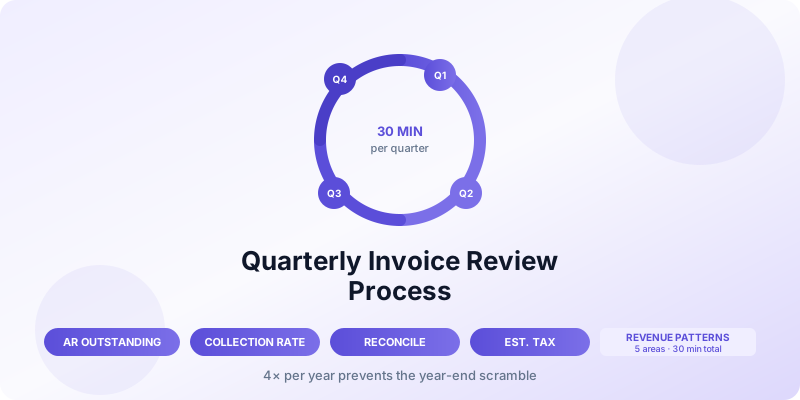
Most invoicing problems compound quietly. A client who paid 45 days late in Q1 becomes a client who doesn't pay at all by Q4. Revenue that looks healthy on the surface hides a cash flow crunch building underneath. A quarterly invoice review — about 30 minutes, four times a year — catches these issues before they become serious.
This guide lays out exactly what to review each quarter, when to do it, and what to do with what you find.
Why Quarterly (Not Annual) Reviews Matter
An annual review at year-end is better than nothing, but it comes too late to fix most problems. By December, a client who's been slow-paying since March has had nine months to drift further. By the time you notice the pattern, you've already delivered all the work.
A quarterly cadence gives you:
- Early warning on slow payers — before they become non-payers
- Accurate estimated tax payments — based on real Q-to-date income
- Clean records throughout the year — reducing the year-end crunch to a 15-minute confirm rather than a 3-hour reconstruction
- Revenue insight — understanding which clients and services actually drive your income
The review is a business health check, not just a bookkeeping task.
When to Do Your Quarterly Review
Align your review with estimated tax payment deadlines — you'll be looking at your numbers anyway:
- Q1 review: Early April (before April 15 estimated tax payment)
- Q2 review: Mid-June (before June 16 estimated tax payment)
- Q3 review: Mid-September (before September 15 estimated tax payment)
- Q4 review: Early January (before January 15 estimated tax payment + preparing for year-end)
Set a recurring calendar event 1–2 weeks before each estimated tax deadline. The review feeds directly into your payment calculation.
The 5-Part Quarterly Invoice Review
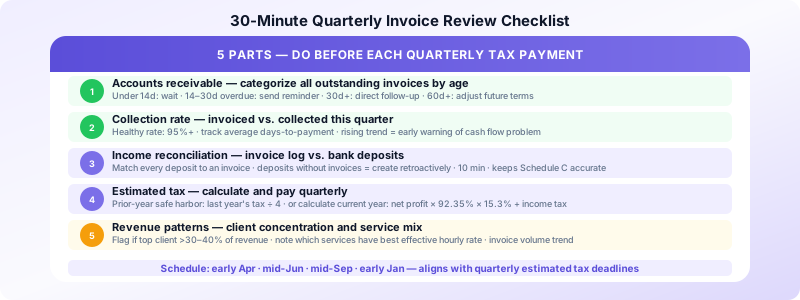
Part 1: Accounts Receivable — What's Outstanding?
Pull a list of every unpaid invoice. For each one:
- Under 14 days: No action needed unless your payment terms have passed.
- 14–30 days past due: Send a reminder. Most late payers in this window just need a nudge.
- 30+ days past due: Escalate. A direct call or firmer email. Ask for a specific payment date.
- 60+ days past due: Evaluate the client relationship and consider whether to require deposits for future work.
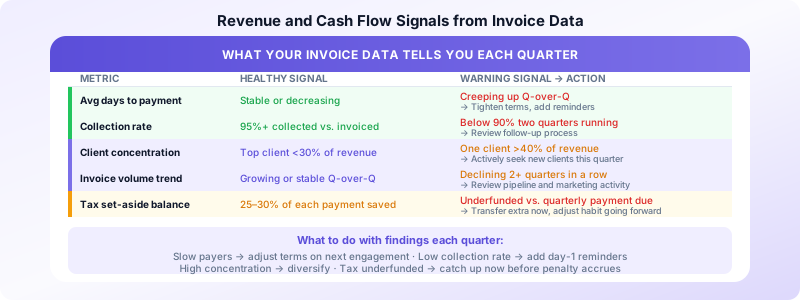
The key metric: Average days to payment. If it's creeping up quarter over quarter, you have a systematic problem — either your payment terms are too loose, you're not following up promptly, or specific clients need stricter terms.
Part 2: Collection Rate — What Actually Got Paid?
Compare invoices issued vs. invoices paid this quarter:
- Total invoiced: All invoices sent in the quarter
- Total collected: All payments received (regardless of when invoiced)
- Collection rate: Collected ÷ invoiced × 100
A healthy collection rate for service businesses is above 95%. If yours is lower, identify which invoices are dragging it down and why.
Also check: are you sending invoices the same day work is complete, or are you batching and delaying? Invoice timing is the single biggest variable in payment speed.
Part 3: Income Reconciliation — Do Your Records Match?
Verify that every payment received this quarter has a corresponding invoice marked paid, and every paid invoice has a matching bank deposit. Specifically:
- Open your invoice log (or app)
- Open your bank statement for the quarter
- Match each deposit to an invoice
- Flag any deposits without invoices (create retroactive invoices)
- Flag any paid invoices without matching deposits (investigate)
This 10-minute reconciliation keeps your Schedule C income accurate and eliminates surprises at tax time. For a full record-keeping system, see our guide on invoice record keeping best practices.
Part 4: Estimated Tax — What Do You Owe This Quarter?
With your Q-to-date income reconciled, calculate your estimated tax payment:
Simple approach (prior year safe harbor): Divide last year's total tax liability by 4. Pay that amount each quarter. This protects you from underpayment penalties regardless of how this year's income compares.
Accurate approach (current year estimate):
- Take your net profit for the quarter (gross income minus deductible expenses)
- Multiply by 92.35% (SE tax adjustment)
- Multiply by 15.3% for SE tax
- Add income tax at your estimated marginal rate
- Set aside that total; pay quarterly
Most sole proprietors earning consistently quarter-over-quarter use the prior year safe harbor for simplicity. If your income is growing significantly, the current year estimate avoids overpaying.
Set-aside habit: Transfer 25–30% of every invoice payment to a separate savings account as you receive it. By the time your quarterly payment is due, the money is already set aside — no scrambling.
Part 5: Revenue Patterns — What's Your Business Health?
This takes 5 minutes and provides real business insight:
Client concentration: What percentage of this quarter's revenue came from your top client? If one client represents more than 30–40% of income, you have concentration risk. A single lost client could cut your income significantly. Diversification is a business objective, not just a nice-to-have.
Service mix: Which services generated the most revenue? Which had the best effective hourly rate? Over time, this data tells you where to focus your marketing and which service lines to expand or drop.
Invoice volume trend: Are you sending more or fewer invoices than the previous quarter? More invoices at the same average value means growing activity. Fewer invoices at higher values could mean fewer clients but deeper relationships. Both can be healthy — what matters is understanding the trend.
What to Do With What You Find
Slow-paying clients: Adjust payment terms for the next engagement — Net 14 instead of Net 30, or require a 50% deposit. It's easier to change terms at the start of a new project than mid-relationship.
Missing invoices: Create them retroactively. Document what work was performed, when, and what was paid. Your records need to be complete.
Low collection rate: Review your follow-up process. If you're not sending reminders within 24 hours of a due date, start. See our guide on following up on unpaid invoices for a complete sequence.
Estimated tax underpayment risk: Pay the catch-up amount now. Underpayment penalties are small but avoidable.
High client concentration: Actively seek new clients this quarter. Identify which service or referral channel brought your current clients and double down on it.
The 30-Minute Quarterly Review Schedule
| Time | Task | |------|------| | 0–10 min | Pull outstanding invoices · categorize by age · send reminders for 14+ day overdue | | 10–20 min | Reconcile paid invoices against bank deposits · flag discrepancies | | 20–25 min | Calculate Q-to-date income · verify estimated tax set-aside | | 25–30 min | Note client concentration · flag any clients needing adjusted terms |
Do this four times a year and your year-end review becomes a 15-minute confirmation, not a crisis. Invoices Customers keeps your invoice history in one place on your iPhone, making the reconciliation step faster — see paid, pending, and overdue at a glance without digging through email.
Sources:
