
Sole Proprietor Invoicing Guide
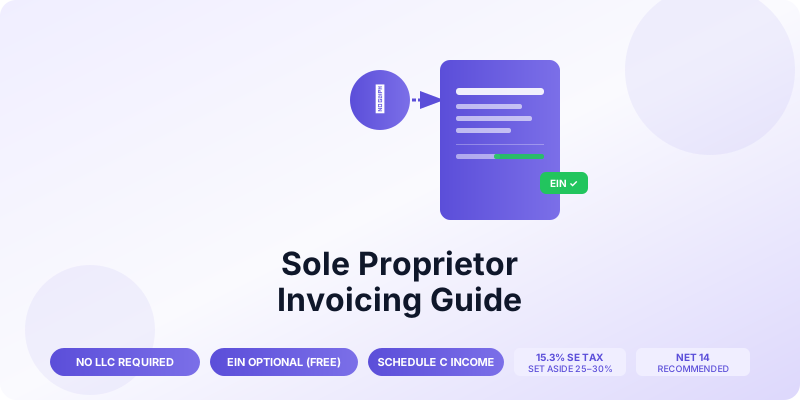
As a sole proprietor, you are your business — there's no legal separation between you and your company. This has real implications for how you invoice. You don't need an LLC, a business bank account, or a special tax ID to send invoices and get paid. But you do need to understand a few things specific to sole proprietors to do it correctly.
What Makes Sole Proprietor Invoicing Different
A sole proprietor is the simplest and most common business structure in the US. You're automatically a sole proprietor when you start doing paid work without forming an LLC or corporation. Most freelancers, independent contractors, and self-employed individuals operate this way.
Key characteristics that affect your invoicing:
- No separate legal entity. You invoice under your own name (or a registered DBA name). There's no "company" separate from you.
- Income on Schedule C. All income you invoice and collect goes on Schedule C of your personal tax return.
- No EIN required — unless you have employees, file certain excise taxes, or have a solo retirement plan.
- Self-employment tax applies. You owe 15.3% SE tax on net profit plus income tax at your marginal rate.
What to Include on a Sole Proprietor Invoice
A legally sufficient invoice for a sole proprietor in the US includes:
Your information:
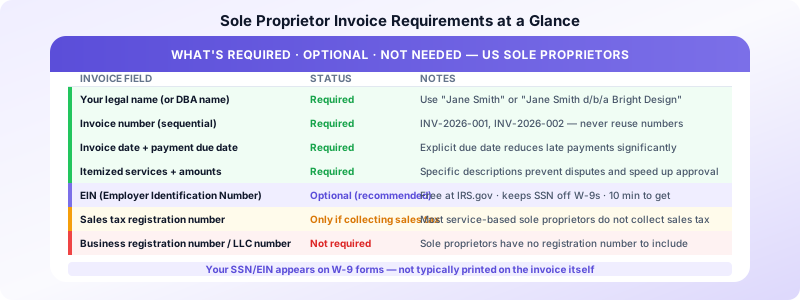
- Your full legal name (or your registered DBA name, e.g., "Jane Smith d/b/a Bright Design")
- Your mailing address
- Your email address
- Your phone number (optional but professional)
Client information:
- Client name or company name
- Client address (for formal invoices; optional for casual service billing)
Invoice details:
- Invoice number (sequential: INV-2026-001)
- Invoice date
- Payment due date (e.g., "Due: May 8, 2026" or "Net 14")
Line items:
- Description of services rendered
- Quantity or hours
- Rate per unit/hour
- Line total
Totals:
- Subtotal
- Sales tax (if you're required to collect it)
- Total due
Payment instructions:
- Accepted payment methods
- Bank transfer details, PayPal, Venmo, or check instructions
You do not need a business registration number or tax ID on most domestic invoices as a sole proprietor.
EIN vs. SSN: What to Put on Your Invoice
This is one of the most common questions for sole proprietors.
Your invoice itself generally does not need your SSN or EIN. Standard invoices only show your name, address, and contact information — not your tax ID.
Your tax ID (SSN or EIN) comes up in two specific situations:
1. When clients request a W-9 form. If a client pays you more than $600 in a year, they may need to file a 1099-NEC and will ask you to complete a W-9. The W-9 requires your taxpayer identification number (TIN). For sole proprietors, this is typically your SSN — though you can use an EIN if you have one.
2. When invoicing internationally or for clients who require it. Some clients or countries require tax identification on the invoice itself. In those cases, use your EIN if you have one (keeps your SSN off paperwork) or your SSN if you don't.
Should you get an EIN? Getting an EIN from the IRS is free and takes about 10 minutes at IRS.gov. Benefits:
- Keeps your SSN off W-9s and client paperwork
- Required if you ever hire employees
- Useful for opening a business bank account
- Some clients prefer it
There's no downside to having an EIN as a sole proprietor. If you haven't gotten one yet, it's worth the 10 minutes.
Sales Tax for Sole Proprietors
Whether you need to collect sales tax depends on:
What you sell. In most US states, services are not subject to sales tax. If you're a writer, designer, developer, consultant, or coach, you typically don't charge sales tax. Physical products are almost always taxable.
Where your client is located. Sales tax is based on the buyer's location (destination-based sourcing in most states). Your home state's rules apply if you and your client are both there.
Economic nexus thresholds. If you sell across state lines, you may have nexus (tax obligation) in states where you exceed $100,000 in sales or 200 transactions per year — but this rarely applies to service-based sole proprietors with modest revenue.
When in doubt: Most service-based sole proprietors earning under $100k from domestic clients don't need to collect sales tax. If you're unsure, check your state's department of revenue website or consult a tax professional.
Payment Terms That Work for Sole Proprietors
Set clear payment terms on every invoice. Recommended defaults:
- Net 14 — 14 days to pay. Standard for most freelance work. Fast enough to maintain cash flow.
- Net 30 — only use when clients specifically require it (common in corporate environments).
- Due on receipt — appropriate for small, one-time services where you want immediate payment.
For new clients: consider requiring a 50% deposit before starting work. This protects you and signals professionalism. State it in your proposal or service agreement first, not just on the invoice.
Late fees: include a late fee clause — typically 1.5% per month on overdue balances. Even if you never enforce it, having it stated reduces late payments.
Record-Keeping for Schedule C
As a sole proprietor, all invoicing income gets reported on Schedule C. Your records need to support that reporting:
Keep a log of every invoice: number, client, amount, date sent, date paid, and payment method. This is your income record. Match it against bank deposits at year-end.
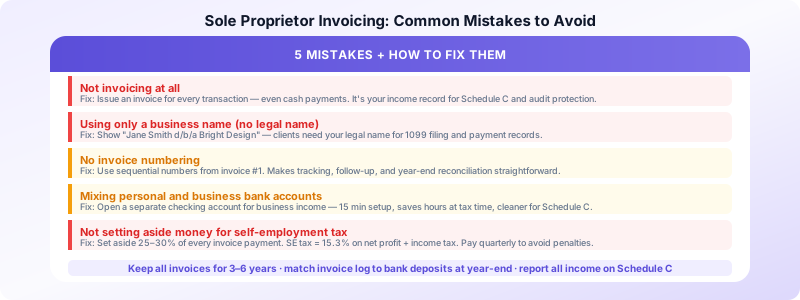
Retain copies of all invoices for at least 3 years (the standard IRS audit window) — 6 years if you have complex returns or significant income. PDFs stored in a cloud folder organized by year is sufficient.
For a full record-keeping framework, see our guide on invoice record keeping best practices.
Common Sole Proprietor Invoicing Mistakes
1. Not invoicing at all. Some sole proprietors accept payment without issuing invoices. This makes record-keeping difficult and creates problems if you're ever audited. Always issue an invoice, even for cash transactions.
2. Using just your business name without your legal name. If you operate as "Bright Design," your invoice should show "Jane Smith d/b/a Bright Design" — or at minimum, your legal name should appear somewhere. Clients need to know who they're paying.
3. No invoice numbering. Sequential numbering is essential for tracking what's paid and what isn't. Without numbers, following up on overdue invoices becomes confusing.
4. Mixing business and personal bank accounts. Not a legal requirement for sole proprietors, but it creates major headaches at tax time. A separate checking account for business income takes 15 minutes to open and makes everything cleaner.
5. Forgetting self-employment tax. Unlike employees who have taxes withheld, sole proprietors pay SE tax themselves. Set aside 25–30% of every invoice payment from day one.
The Bottom Line
Invoicing as a sole proprietor is straightforward: send a professional invoice with your name, the work description, amount, and payment terms — then track it until it's paid and file it for your taxes. No LLC required, no EIN required (though worth getting), no complex setup.
If you're just starting out, see our guide on how to set up invoicing for a new freelance business for a complete first-day checklist. For creating and sending invoices from your iPhone in under 2 minutes, Invoices Customers is built for exactly this workflow — no subscription, no overhead.
Sources:
