
How to Track Business Expenses Effectively

Every dollar you spend on your business matters. Knowing how to track business expenses accurately is one of the most important financial habits you can build as an entrepreneur or freelancer. Without a system in place, you risk overspending, missing tax deductions, and losing control of your cash flow.
The good news: expense tracking does not require an accounting degree. You just need the right approach and a bit of consistency. This guide walks you through practical methods to track every business expense, from daily purchases to annual subscriptions.
Why Expense Tracking Matters More Than You Think
Skipping expense tracking is like driving without a fuel gauge. You might get by for a while, but eventually you will run into trouble.
Accurate records help you claim every tax deduction you are entitled to. The IRS allows deductions for legitimate business expenses, but only if you can prove them. Missing receipts and vague records mean money left on the table.
Beyond taxes, tracking expenses gives you a clear picture of where your money goes each month. You can spot unnecessary subscriptions, negotiate better rates with vendors, and make smarter decisions about pricing your services.
Separate Business and Personal Finances
The single most important step is keeping business and personal spending apart. Open a dedicated business checking account and use a separate credit card for business purchases.
This separation makes expense tracking dramatically easier. Every transaction on your business card is, by definition, a business expense. You eliminate the tedious work of scrolling through mixed statements and trying to remember which coffee was a client meeting and which was personal.
If you are a freelancer or sole proprietor, this also protects you during audits. A clear boundary between business and personal spending shows the IRS you take your business seriously.
Choose Your Tracking Method
There is no single right way to track expenses. The best method is the one you will actually use every day. Here are the most common approaches.
Spreadsheet tracking works well if you have a small number of monthly transactions. Create columns for date, vendor, amount, category, and payment method. Update it weekly so receipts do not pile up.
Dedicated accounting software like QuickBooks or Wave automates categorization and connects directly to your bank account. This saves time but adds a monthly cost.
Receipt scanning apps let you photograph receipts on the spot. The text gets extracted automatically, so you never lose a paper receipt again.
The envelope method is a simple analog approach. Label envelopes by expense category (office supplies, travel, software, meals) and drop receipts into the right one throughout the month. At month-end, total each envelope.
Pick one method and commit to it for at least 90 days before switching. Consistency beats perfection.
Set Up Expense Categories That Make Sense

Generic categories create generic insights. Build categories that match how your business actually spends money. A graphic designer and a plumber have very different expense profiles.
Start with these common categories and customize from there:
- Software and subscriptions (design tools, project management, cloud storage)
- Office supplies (paper, ink, hardware)
- Travel and transportation (mileage, flights, parking)
- Professional development (courses, books, conferences)
- Marketing and advertising (ads, website hosting, business cards)
- Client meals and entertainment (keep receipts and note who attended)
- Insurance (liability, health, equipment)
- Contract labor (subcontractors, virtual assistants)
Review your categories quarterly. If a category consistently shows zero spending, remove it. If you keep lumping unrelated expenses together, split that category into two.
Build a Weekly Expense Review Habit
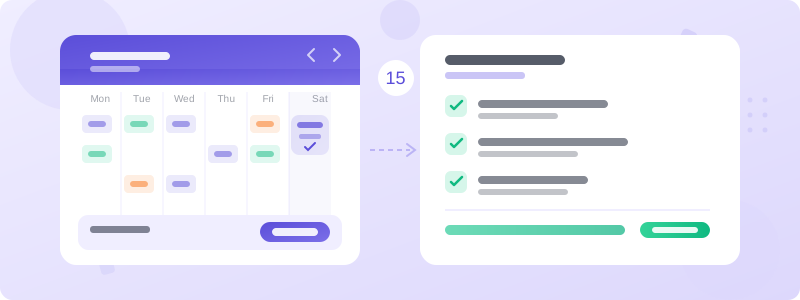
Tracking expenses once a year before tax season is a recipe for stress and missed deductions. Instead, schedule a 15-minute weekly review every Friday.
During your weekly review, do three things. First, log any expenses you have not yet recorded. Second, photograph and file any paper receipts. Third, verify that your totals match your bank statement for the week.
This weekly habit turns tax season from a multi-day scramble into a quick review. When you invoice clients, you can also cross-reference project expenses against what you billed, catching any costs you forgot to include.
Using Invoices Customers, you can track what clients owe you alongside your expense records. When you know exactly what is coming in and going out, you make better financial decisions.
Use Your Invoicing Tool to Connect the Dots
Expense tracking and invoicing are two sides of the same coin. Every invoice you send represents income, and every expense reduces your taxable profit. Keeping both in sync gives you an accurate financial picture at all times.
When you create an invoice in Invoices Customers, you capture the revenue side of a project. Pair that with your expense records for the same project, and you instantly see your true profit margin. A project that billed $5,000 but cost $3,200 in materials and subcontractor fees earned you $1,800, not $5,000.
This project-level tracking helps you decide which types of work are most profitable. Over time, you can shift toward higher-margin projects and phase out work that barely covers costs.
Keep Records for the Right Amount of Time
The IRS recommends keeping tax-related records for at least three years. If you underreported income by more than 25%, that window extends to six years. For asset-related records (equipment purchases, vehicle depreciation), keep documentation for as long as you own the asset plus three years.
Digital storage makes this easy. Scan paper receipts and save them in a folder structure organized by year and category. Cloud backup ensures you do not lose everything if your phone or laptop fails.
Name files consistently. A format like "2026-03-22_officesupplies_staples_47.50.pdf" lets you find any receipt in seconds.
Start Tracking Your Expenses Today
Learning how to track business expenses is not complicated, but it does require action. Open that separate bank account. Pick a tracking method. Set your Friday review reminder. Start this week, not next month.
The entrepreneurs who stay profitable long-term are the ones who know their numbers. Pair your expense tracking with professional invoicing through Invoices Customers to manage both sides of your business finances from your phone. Your future self, and your accountant, will thank you.
