
VAT on Invoices for International Clients: A Clear Guide
If you've ever stared at an invoice template and wondered whether to add VAT for your international client, you're not alone. VAT on invoices for international clients is one of the most common sources of confusion for freelancers and small business owners. The good news: once you understand a few key rules, it becomes straightforward.
This guide covers when VAT applies, what the reverse charge mechanism is, and exactly what to write on your invoices for clients outside your country.
When You Charge VAT — and When You Don't
VAT (Value Added Tax) is a consumption tax applied in most countries outside the United States. Whether you charge VAT on international invoices depends on two things: where you're based, and whether your client is a business or a private individual.
If you're based in a VAT-registered country (e.g., UK, Germany, Australia):
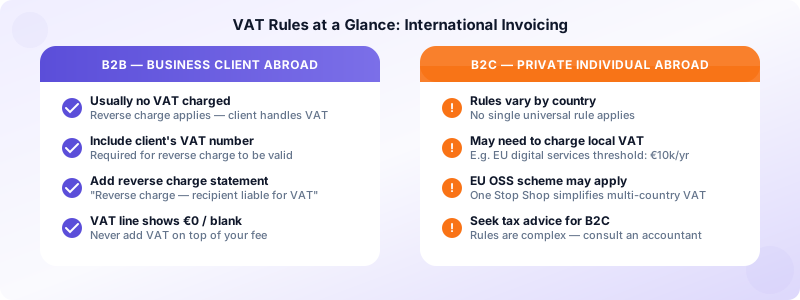
- Selling to a registered business in another VAT-registered country: typically don't charge VAT — the reverse charge mechanism applies
- Selling to a private individual abroad: you may need to charge VAT at your local rate or register in the buyer's country
- Selling to any client in a non-VAT country (e.g., most US services): generally no VAT required
If you're based in the US:
The US uses sales tax, not VAT. When invoicing international clients, US-based freelancers typically don't charge VAT at all. However, if you have significant operations or sales in a country with VAT (like EU countries), you may need to register there.
The safest starting rule: B2B (business-to-business) international services usually don't involve you collecting VAT. B2C (business-to-consumer) is more complex and varies by country.
What Is the Reverse Charge Mechanism?
The reverse charge is the most important concept to understand when invoicing international business clients. Here's how it works:
Normally, the seller (you) charges VAT and passes it to the government. Under the reverse charge, the buyer (your client) handles the VAT reporting themselves. You invoice without adding VAT, and your client reports the VAT in their own country.
This simplifies cross-border trade dramatically. You don't need to register for VAT in every country you have clients in. Your EU client, for example, declares the VAT on their own return — and if they're VAT-registered, they typically claim it right back, making the transaction VAT-neutral for them.
When the reverse charge applies:
- You're providing services to a VAT-registered business in another country
- It's a B2B transaction (business to business)
- The services are "general rule" services (consulting, design, development, marketing, etc.)
The mandatory invoice wording: When the reverse charge applies, your invoice must state it explicitly. Use language like: "VAT reverse charge applies — Article 196, Council Directive 2006/112/EC" (for EU clients) or simply "Reverse charge — recipient is liable for VAT."
Leave the VAT amount line at €0 or blank. Do not add VAT. Do include your client's VAT registration number on the invoice.
What to Include on Your International Invoice
Whether you're applying VAT or using the reverse charge, international invoices need additional fields compared to domestic ones.
Always include:
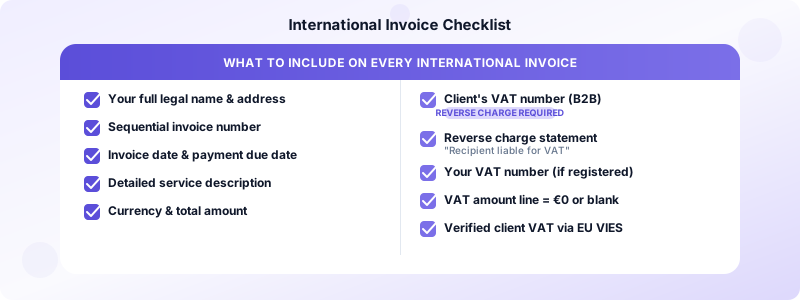
- Your full legal name or business name and address
- Invoice number (sequential — e.g., INV-2026-047)
- Invoice date and payment due date
- Description of services (be specific — vague descriptions create issues at customs and audits)
- Currency and total amount
For reverse charge invoices, also include:
- Your client's VAT registration number (verify it before sending — invalid numbers cause rejections)
- A clear "reverse charge" statement
- Your own VAT number (if you're VAT-registered)
For invoices where you charge VAT:
- Your VAT registration number
- The VAT rate applied
- The VAT amount as a separate line item
- The total including VAT
Invoices Customers lets you add custom line items and notes to your invoices, making it easy to include reverse charge wording and VAT numbers directly in your invoice PDF. For guidance on creating a complete professional invoice, see our guide on how to create professional invoices.
Common VAT Mistakes on International Invoices
Charging VAT to a foreign business client when you shouldn't. If the reverse charge applies, adding VAT creates accounting headaches for your client. They'll likely ask you to reissue the invoice. Check whether your client is VAT-registered before sending.
Not including the client's VAT number. For EU reverse charge to apply, your invoice needs their VAT number. Always ask for it before the first invoice. You can verify EU VAT numbers free at the EU VIES database (ec.europa.eu/taxation_customs/vies/).
Using vague service descriptions. "Consulting services" is technically acceptable, but "Brand strategy consulting for Q1 2026 product launch" is better. Clear descriptions reduce questions, especially if the invoice is ever reviewed by tax authorities.
Assuming the same rules apply everywhere. The EU has specific rules. The UK has post-Brexit rules. Australia has GST. Canada has GST/HST. Always verify the specific rules for your client's country — particularly for new country relationships.
Ignoring thresholds. Some countries only require VAT registration above a certain revenue threshold. In the EU, if you sell digital services to private individuals above €10,000/year across EU member states, you need to register (or use the OSS scheme).
A Practical Example
You're a freelance designer in the US. Your client is a marketing agency in Germany.
- The German agency is VAT-registered (they'll give you their Umsatzsteuer-ID starting with DE)
- Your service is "general rule" — reverse charge applies
- Your invoice: no VAT charged, include their VAT number, add the statement "Reverse charge — recipient is liable for VAT"
- Total on invoice: €2,400 (your design fee only)
The German agency reports €2,400 at the German VAT rate on their return, then reclaims it. The invoice is clean, compliant, and paid without confusion.
Now the same designer invoices a private German individual for a personal logo. This is B2C. The rules are different — you may need to charge German VAT (currently 19%) or register for the EU One Stop Shop (OSS). This is where professional tax advice pays off.
Keep Your International Invoices Organized
Good record-keeping is especially important for international invoices. Tax authorities in your home country may ask for evidence that you correctly applied (or didn't apply) VAT on cross-border transactions.
Keep a copy of every international invoice, the client's VAT number you verified, and any correspondence about the service. Store these organized by year and client for easy retrieval.
For broader guidance on managing international clients, see our post on how to invoice international clients.
Download Invoices Customers to create clean, professional invoices with all the fields you need for international clients — no account needed, all data stays on your device.
