
Year-End Invoice Review Checklist
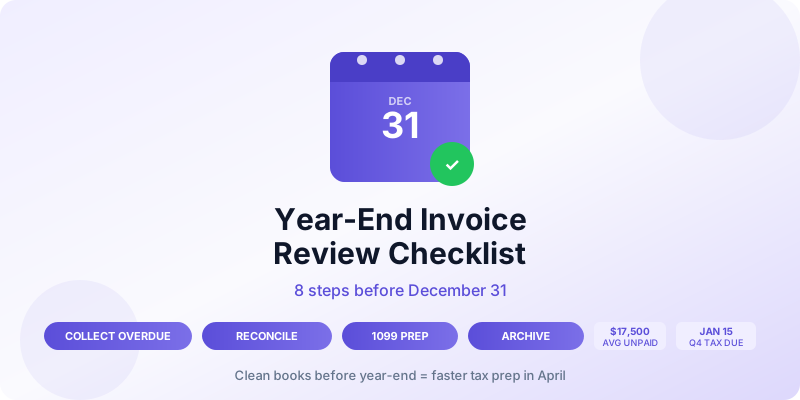
The end of the year is the best time to audit your invoicing — chase down unpaid balances, close your books cleanly, and make sure your income records are complete before tax season hits. US small businesses carry an average of $17,500 in unpaid invoices, much of which could be collected with a systematic year-end push.
This checklist walks through every step, from outstanding invoices to 1099 prep to setting up a cleaner system for next year.
Step 1: Pull Your Accounts Receivable Report
Start by listing every invoice that hasn't been fully paid:
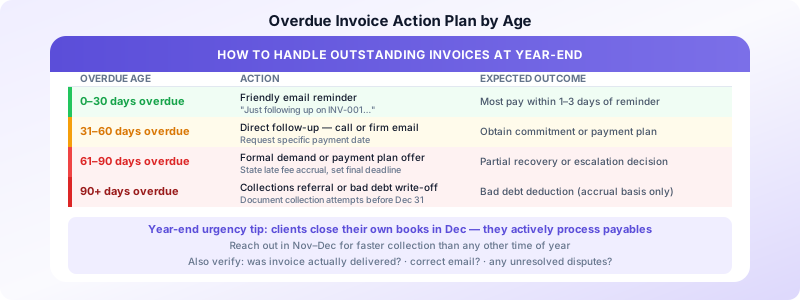
- 0–30 days overdue: Send a polite reminder. Most late payers in this bucket just need a nudge.
- 31–60 days overdue: More direct follow-up. Call or email with a specific payment request and deadline.
- 61–90 days overdue: Consider a formal demand letter or offer a payment plan to recover something.
- 90+ days overdue: Evaluate whether to write off as bad debt or refer to collections. If written off, document it — bad debt may be deductible.
For each outstanding invoice, verify:
- Is the client email and contact information still correct?
- Was the invoice actually delivered (check sent folder)?
- Did the client raise any disputes you haven't resolved?
Year-end urgency works in your favor. Many clients close out their own books in December and actively process outstanding payables. Reaching out in November–December often yields faster payment than any other time of year.
Step 2: Reconcile Your Invoice Records
Your invoice log should match your bank deposits. Go through each payment received during the year and confirm:
- Every deposit has a corresponding invoice marked paid
- Every paid invoice has a matching deposit amount and date
- No payments were received without an invoice being issued
Discrepancies to investigate:
- Payments in a different amount than invoiced (partial payment, rounding, currency conversion)
- Deposits with no invoice (cash transactions, informal arrangements)
- Invoices marked paid with no matching bank deposit
This reconciliation is your income verification for Schedule C. Gaps here become problems in April.
Step 3: Write Off Uncollectible Invoices
If you use accrual accounting (you record income when invoiced, not when paid), uncollectible invoices can be deducted as bad debt. For most freelancers on cash-basis accounting (record income when received), this doesn't apply — you simply haven't recorded that income.
To write off a bad debt (accrual basis):
- Make a genuine effort to collect (document your attempts)
- Determine the debt is genuinely uncollectible
- Write it off before December 31
- Keep documentation of the debt and collection efforts
Consult a tax professional if you have significant uncollected amounts — the rules differ by accounting method and business type.
Step 4: Prepare for 1099-NEC Filings
If you paid contractors or service providers more than $600 during the year, you're required to issue 1099-NEC forms by January 31. Conversely, clients who paid you more than $600 should issue you a 1099-NEC.
As a payer (if you hired contractors):
- Collect W-9 forms from all contractors paid $600+ this year (do this before year-end while the relationship is fresh)
- Verify names, addresses, and tax IDs on file
- Plan to file 1099-NEC forms by January 31
As a payee (you're receiving 1099s):
- Confirm your own W-9 information is current with clients who paid you $600+
- Verify your address is correct for mailed forms
- Cross-reference 1099s received against your own income records when they arrive in January–February
1099-K (payment processors): If clients paid you via PayPal, Venmo, Stripe, or similar platforms, those platforms issue a 1099-K once you exceed $2,500 in 2025 (dropping to $600 in 2026). This doesn't change your tax obligation — all income is taxable regardless — but reconcile these against your invoice records.
Step 5: Verify Your Invoice Archive
Confirm you have copies of every invoice issued this year:
- All invoices filed or accessible (cloud folder, app, or software export)
- Invoice numbers are sequential with no gaps
- Voided or cancelled invoices are noted (not deleted)
- Year-to-date totals match your income ledger
The IRS can audit returns for up to 3 years (6 years if they suspect substantial underreporting). Keep all invoices and payment records for at least 3–6 years after filing. For a full record-keeping framework, see our guide on invoice record keeping best practices.
Step 6: Review Your Invoicing Process for the New Year
Year-end is the right time to fix what didn't work. Ask yourself:
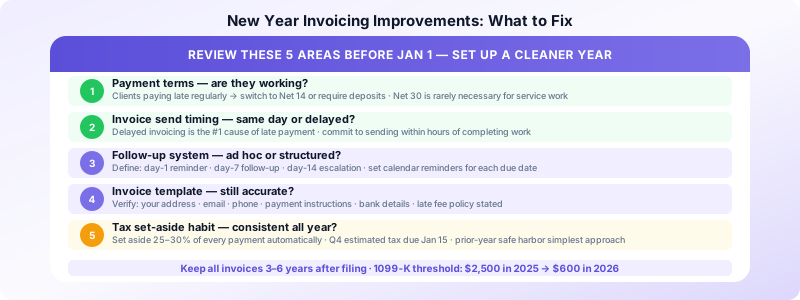
Which clients paid late most often? Consider adjusting payment terms for those clients — shorter due dates, deposit requirements, or automatic reminders.
Are your payment terms still appropriate? If you're consistently waiting Net 30+ to get paid, switching to Net 14 as your standard could significantly improve cash flow.
Are you sending invoices immediately? The most common cause of late payment is delayed invoicing. If you waited days or weeks to send invoices this year, build a same-day invoicing habit for next year.
What's your follow-up process? Clients who paid late — did you have a system for reminders, or did you handle it case-by-case? A defined follow-up sequence (day 1, day 7, day 14+) removes friction. See our guide on following up on unpaid invoices for a complete system.
Is your invoice template current? Check that your address, contact information, and payment instructions are still accurate.
Step 7: Set Aside Estimated Tax for Q4
If you make quarterly estimated tax payments, the Q4 payment covers income earned October–December, due January 15 of the following year. Verify:
- You've set aside approximately 25–30% of Q4 invoiced income
- Your Q4 estimated payment amount is calculated (prior year safe harbor or 90% of current year liability)
- Payment is scheduled before January 15
Underpaying estimated taxes results in a penalty — not a large one, but avoidable. If this is your first year of self-employment, the prior year safe harbor (paying 100% of last year's tax liability in equal quarterly installments) is the simplest approach.
The Complete Year-End Checklist
Run through this before December 31:
- Pull accounts receivable — follow up on all outstanding invoices
- Reconcile invoice log against bank deposits
- Write off genuinely uncollectible invoices (accrual-basis only)
- Collect W-9s from any contractors you paid $600+
- Verify your W-9 info is current with your major clients
- Archive and verify all invoices are filed
- Review payment terms and invoicing habits for the new year
- Set aside Q4 estimated tax — pay by January 15
Invoices Customers makes this review straightforward — all your invoices are in one place on your iPhone, with status tracking so you can see at a glance what's paid, pending, and overdue. No subscription required.
Sources:
