
Small Business Client Management Tips That Work

Your skills got you the client. But keeping that client — and keeping them happy — is an entirely different challenge. For small business owners, client management is the invisible engine behind repeat work, referrals, and steady revenue. Without a system, you end up chasing details, missing follow-ups, and losing money to disorganization.
These small business client management tips will help you build a repeatable process for onboarding, communicating with, billing, and retaining every client you work with. Whether you run a one-person operation or a small team, the strategies here are practical and immediately actionable.
Set Up a Client Information System From Day One
You can't manage what you don't track. The first step in client management is creating a centralized place to store every client's details: name, business name, email, phone, billing address, tax ID, preferred payment method, and any project-specific notes.
Many small business owners start with spreadsheets. That works until you have 15 clients and need to find a billing address at 9 PM on a Friday. A better approach is using a tool that ties client information directly to your invoicing workflow. Invoices Customers lets you save client details — including addresses and tax info — so you can pull them up instantly when creating an invoice or estimate.
Here's what your client record should include at minimum:
- Contact details. Full name, email, phone number, and company name.
- Billing information. Address, tax identification number, and preferred payment terms.
- Project history. A running list of past projects, invoices, and any notes about preferences or special requirements.
- Communication log. Key dates like when you last followed up, when contracts were signed, and any important decisions made.
Build this habit with your very first client. Updating records takes 2 minutes per project. Reconstructing missing information later takes hours — if you can recover it at all.
Onboard New Clients With a Clear Process
The first 48 hours of a client relationship set the tone for everything that follows. A sloppy onboarding experience signals disorganization. A smooth one signals professionalism and builds immediate trust.
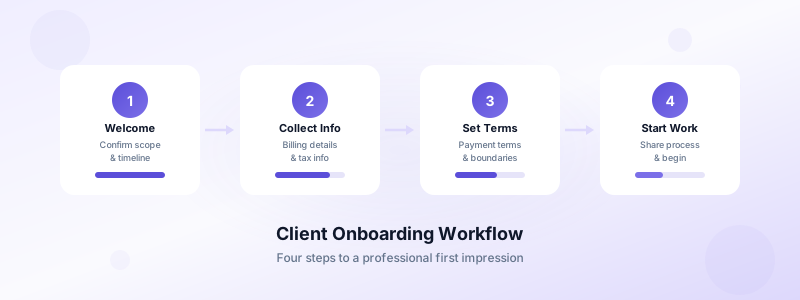
Your onboarding process should cover five things:
1. Send a welcome message. Confirm the scope of work, timeline, deliverables, and your contact information. A simple email works. The goal is to eliminate ambiguity before work begins.
2. Collect all necessary information upfront. Don't chase billing details after you've finished the work. Get their business name, billing address, tax ID, and preferred payment method during onboarding. This saves you time when you invoice as a freelancer later.
3. Set communication expectations. Tell clients how you prefer to communicate (email, phone, messaging app), your response time (e.g., within 24 hours on business days), and when you're available. Boundaries established early are respected. Boundaries established after a conflict are resented.
4. Confirm payment terms. State your rates, payment schedule, and when invoices are due. If you charge a deposit, collect it before starting work. Putting this in writing avoids disputes later. For more on this topic, see our guide on getting clients to pay on time.
5. Share your process. Clients feel more comfortable when they know what to expect. Explain your workflow: how you'll deliver drafts, how revisions work, and when they'll receive the final deliverable. Transparency reduces back-and-forth.
Create a simple onboarding checklist you can reuse for every client. Over time, this becomes second nature and takes less than 15 minutes per new engagement.
Communicate Proactively, Not Reactively
The number one complaint clients have about service providers isn't quality — it's communication. Silence creates anxiety. When a client hasn't heard from you in two weeks, they assume the worst: the project is behind, you forgot about them, or you don't care.
Proactive communication solves this entirely. Here's what it looks like in practice:
- Send weekly updates on active projects. Even a two-sentence email — "Making good progress on your website redesign. On track to deliver the first draft by Thursday." — eliminates anxiety and builds confidence.
- Flag problems early. If a deadline is slipping or a scope change is needed, tell the client immediately. Most clients handle bad news well when it comes early. They handle surprises poorly.
- Confirm receipt of deliverables. After sending work, follow up within 48 hours if you haven't heard back. A simple "Just checking in — did you get a chance to review the files?" keeps projects moving.
- Document decisions. After a phone call or meeting, send a brief summary email. "Per our call today, we agreed to X, Y, and Z." This protects both you and the client from misunderstandings.
One useful rule: if you're thinking about the client, contact them. That instinct usually means an update is overdue.
Handle Scope Creep Before It Destroys Profitability
Scope creep is the silent profit killer for small businesses. It starts innocently — "Can you also tweak this one thing?" — and escalates until you've done 40% more work than you quoted. The problem isn't the client asking. The problem is you not having a system to respond.
Here's how to manage scope effectively:
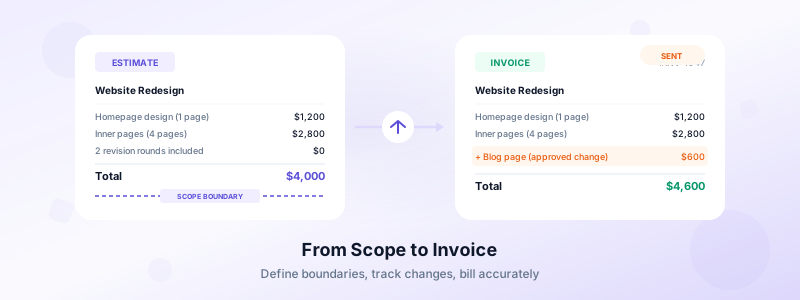
Define deliverables precisely. Your estimate or contract should list exactly what's included. Instead of "website redesign," specify "redesign of 5 pages (Home, About, Services, Contact, Blog) with up to 2 rounds of revisions." Specificity is your boundary.
Create a change request process. When a client asks for something outside scope, respond with: "Great idea. That falls outside our current agreement, so let me put together a quick estimate for the additional work." This is professional, not confrontational. It frames extra work as extra value, not a favor.
Track hours even on fixed-price projects. You need to know when scope creep is happening. If a $2,000 project is consuming 30% more hours than estimated, you have data to adjust your pricing or process for next time.
Use estimates as boundaries. Send a formal estimate for any additional work before starting it. Tools like Invoices Customers let you create estimates quickly and convert them to invoices with one tap once the client approves. This creates a paper trail that protects your profitability.
The goal isn't to nickel-and-dime clients. It's to ensure that every hour of your work is accounted for and compensated.
Build a Billing System That Strengthens Relationships
Invoicing isn't just a financial transaction — it's a client touchpoint. A professional, timely, accurate invoice reinforces trust. A late, sloppy, or confusing one erodes it.
Here's how to turn billing into a relationship-building tool:
Invoice promptly. Send your invoice the same day you deliver final work or hit a milestone. Delays signal disorganization and push your payment further into the future. If you follow the tips in our freelance invoice template guide, your invoices will look polished and contain every detail clients need to pay you quickly.
Make invoices crystal clear. Every line item should describe what the client is paying for. Instead of "consulting services — $3,000," break it down: "Brand strategy workshop (4 hours) — $1,200" and "Logo design with 3 concepts and 2 revision rounds — $1,800." Detailed invoices get fewer questions and faster payments.
Be consistent with timing. If you bill on the 1st and 15th of each month, stick to that schedule. Clients budget around predictable expenses. Consistency also trains clients to expect your invoice, which means faster approvals.
Follow up politely but firmly. If payment is overdue, send a reminder at 3 days, 7 days, and 14 days past due. Keep the tone professional. Most late payments are due to oversight, not malice. A simple "Just a friendly reminder that Invoice #1047 is past due" usually does the trick.
Track invoice status. Know which invoices are outstanding, which are overdue, and which are paid at all times. Invoices Customers gives you status tracking — outstanding, overdue, and paid — so nothing slips through the cracks.
Retain Clients by Delivering Consistent Value
Acquiring a new client costs 5-7 times more than retaining an existing one. Yet most small business owners spend 90% of their energy on acquisition and almost none on retention. Flip that ratio and your revenue becomes far more predictable.
Client retention comes down to three things:
Reliability. Do what you said you'd do, when you said you'd do it. Meet every deadline. Deliver every promise. Over time, reliability becomes your brand. Clients stop considering alternatives because they trust you completely.
Small touches that show you care. Remember details about their business. Reference previous conversations. Send a brief check-in email between projects: "How did the product launch go? I'd love to hear how the branding materials performed." These small gestures take 5 minutes but create loyalty that lasts years.
Make it easy to work with you again. When a past client reaches out for new work, don't make them repeat their billing details, explain their preferences again, or remind you of their business context. Having their complete profile saved in your client management system means you can pick up right where you left off. That seamlessness signals a level of professionalism that clients notice and appreciate.
Track your client retention rate. If you're losing more than 30% of clients annually (outside of one-time project clients), something in your process needs attention. Survey departing clients to learn why.
Build Your Client Management System Today
Strong client management doesn't require expensive software or complex processes. It requires consistency: a reliable way to store client information, a repeatable onboarding process, proactive communication habits, clear scope boundaries, professional billing practices, and deliberate retention efforts.
Start with the basics. Set up your client records, create an onboarding checklist, and establish a billing schedule. These three steps alone will transform your client relationships and your cash flow.
Small business client management tips work best when backed by the right tools. Download Invoices Customers to keep your client details organized, send professional invoices, and track payment status — all from your iPhone. Your clients will notice the difference.
