
E-Invoicing Compliance Requirements for 2026
A wave of e-invoicing mandates is rolling across the globe in 2026, and small businesses are caught in the current. Belgium, Poland, and France are all enforcing new structured invoicing rules this year, with Germany and Spain close behind. Even if you operate entirely in the United States — where no federal mandate exists yet — your international clients may already expect compliant invoices from you.
Staying ahead of these requirements protects your cash flow, prevents penalties, and positions your business as a reliable partner. This guide maps out the key compliance deadlines, explains what they mean for businesses of every size, and gives you a clear action plan to prepare.
Why E-Invoicing Mandates Are Accelerating
Governments worldwide are shifting to e-invoicing because it closes tax gaps, reduces fraud, and speeds up commerce. Traditional paper and PDF invoices rely on manual data entry, which introduces errors and makes tax evasion harder to detect. Structured e-invoices, by contrast, flow directly between financial systems in machine-readable formats, giving tax authorities real-time visibility into transactions.
The European Union's VAT in the Digital Age (ViDA) initiative is the driving force in Europe. ViDA aims to harmonize e-invoicing requirements across all EU member states by 2030, but individual countries are moving faster on their own timelines. Outside Europe, nations in the Middle East and Latin America are expanding mandates down to small and mid-sized businesses.
For small business owners, this matters because compliance deadlines do not wait. If you invoice a client in Belgium or France, their government expects a structured digital document — not a PDF attachment. Understanding the timeline now gives you room to adapt without rushing. If you are new to the concept, our guide on what e-invoicing is and why it matters covers the fundamentals.
Key Country Deadlines for 2026
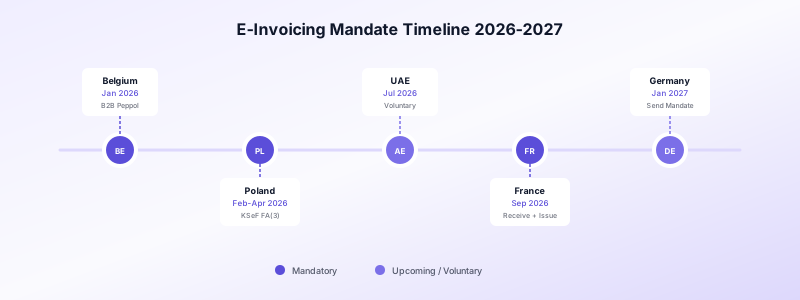
Here is a breakdown of the most significant e-invoicing mandates taking effect this year and into early 2027.
Belgium — January 2026. Belgium launched its Peppol-based B2B e-invoicing mandate at the start of the year. All Belgian businesses must now issue and receive structured e-invoices for domestic B2B transactions. A three-month grace period ran through March 2026, but penalties for non-compliance are now active. If you have Belgian clients, they need invoices in Peppol BIS format.
Poland — February to April 2026. Poland's KSeF (National e-Invoicing System) became mandatory for large taxpayers in February 2026. By April 2026, all remaining taxpayers must comply. Poland uses its own proprietary XML schema called FA(3) — no other formats are accepted for domestic B2B transactions.
France — September 2026. France requires all businesses to receive e-invoices starting September 2026. Large and mid-sized companies must also issue e-invoices at this date. Small businesses and micro-enterprises have until September 2027, but the receive obligation begins this year. France uses certified platforms called Plateformes de Dématérialisation Partenaires (PDP) to route invoices.
Germany — January 2027. While the deadline falls just outside 2026, preparation starts now. German companies have been required to accept e-invoices since January 2025. The obligation to send e-invoices begins January 2027, with an extra year for small businesses earning under 800,000 euros annually.
UAE — July 2026 onward. The UAE begins voluntary e-invoicing adoption in July 2026, with mandatory compliance for large taxpayers starting January 2027.
What These Mandates Mean for U.S. Small Businesses
The United States does not have a federal e-invoicing mandate. You face no legal obligation to issue or receive structured e-invoices for domestic transactions. However, that does not mean you can ignore these changes.
If you invoice clients in Belgium, France, Poland, or any country with an active mandate, you need to deliver invoices in the format their government requires. Sending a PDF to a Belgian client who needs a Peppol-compliant document will cause payment delays and frustration on both sides.
Even for purely domestic businesses, the trend is clear. The Digital Business Networks Alliance (DBNAlliance) is building a U.S. e-invoice exchange framework, and the Federal Reserve has completed pilot testing of a Peppol-based network. Industry adoption is accelerating even without a legal requirement.
The practical takeaway: you do not need to panic, but you should prepare. Making sure your invoices already contain all the required data fields — seller details, buyer details, itemized lines, tax amounts, and payment instructions — means you are ready to plug into any structured format when the time comes. For a refresher on essential invoice elements, see our checklist on what to include on an invoice.
How to Prepare Your Business for Compliance
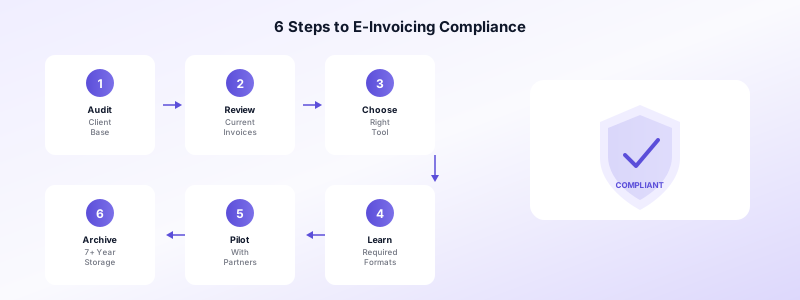
You do not need an enterprise budget or a dedicated IT department to get ready. Here is a step-by-step approach that works for businesses of any size.
1. Audit your client base. List the countries where your clients operate. Cross-reference that list with active and upcoming e-invoicing mandates. This tells you which deadlines apply to your business right now.
2. Review your current invoices. Open a recent invoice and check whether it includes every field a structured e-invoice requires: your business name and tax ID, the client's name and tax ID, a unique invoice number, the invoice date and due date, itemized line descriptions with quantities and prices, tax rates and amounts, and payment instructions. If any fields are missing, fix your template now.
3. Choose the right invoicing tool. Your software should make it easy to create detailed, properly structured invoices. Invoices Customers lets you build professional invoices on your iPhone with all the essential fields — line items, tax calculations, client details, and clear payment terms. Starting with well-structured data today means the transition to e-invoicing formats will be straightforward when your clients or governments require it.
4. Understand the formats. Different countries use different standards. Peppol BIS is the most widely adopted in Europe. Poland uses FA(3). Italy uses FatturaPA. You do not need to master every format, but knowing which ones your clients' countries require helps you choose compatible tools and partners.
5. Start with willing partners. If you have clients in countries with active mandates, reach out and ask how they want to receive invoices. Many will direct you to a specific platform or network. Piloting with a few clients lets you work out any issues before deadlines hit.
6. Archive properly. Most e-invoicing regulations require you to store invoices digitally for at least seven years. Set up a consistent archiving system now rather than scrambling later.
Common Mistakes to Avoid
Businesses that wait until the last minute often make preventable errors. Here are the most common pitfalls.
Assuming PDF equals e-invoice. A PDF sent by email is a digital document, but it is not an e-invoice. E-invoicing requires structured, machine-readable data in a specific format. Do not confuse the two. If you are still working with paper processes, our guide on switching from paper to digital invoicing can help you take the first step.
Ignoring client-country requirements. Your compliance obligations depend on where your client is located, not just where you are. A U.S. freelancer invoicing a French company will need to meet French requirements by September 2026.
Missing required fields. E-invoicing systems validate data automatically. A missing tax ID, incorrect tax rate, or absent line-item description will cause the invoice to be rejected. Build completeness into your invoicing habit now using Invoices Customers so every document you send already has the right structure.
Using incompatible formats. Not all e-invoicing standards are interchangeable. An invoice formatted for Peppol will not work on Poland's KSeF platform without conversion. Verify the correct format before sending.
Neglecting archiving rules. Compliance does not end when the invoice is sent. Most mandates require digital storage for a minimum number of years. Deleting old invoices or relying on email as your archive creates compliance risk.
Take Control of Your Invoicing Today
The consequences of non-compliance vary by country, but they follow the same pattern. Tax authorities may reject non-compliant invoices, which means your client cannot process the payment and you do not get paid. Some countries impose direct fines — Poland, for example, can levy penalties of up to 100 percent of the VAT amount on non-compliant invoices. Beyond penalties, non-compliance creates friction with clients who may eventually choose vendors that make their accounting easier.
The simplest way to avoid these issues is to start preparing now rather than reacting after a deadline passes. E-invoicing mandates are active right now in multiple countries and expanding rapidly. Whether you already invoice international clients or you want to be ready when U.S. requirements arrive, the foundation is the same: create detailed, well-structured invoices with every required field in place.
Download Invoices Customers and start building professional invoices on your iPhone today. With proper line items, tax details, and client information baked into every document, you will be ready for whatever compliance requirements come next — no scrambling required.
