
Invoice Numbering System Best Practices
A single duplicated invoice number can trigger an audit, confuse your bookkeeping, and delay a payment by weeks. Your invoice numbering system is the backbone of your financial records, and getting it right from day one saves you from headaches that compound over time. These invoice numbering system best practices will help you build a structure that scales with your business.
Whether you send five invoices a month or fifty, a consistent numbering approach keeps every transaction traceable, every record clean, and every client confident in your professionalism.
Why Your Invoice Numbering System Matters
Invoice numbers do more than label a document. They serve as unique identifiers that connect your invoices to payments, tax filings, and client records. Without a reliable system, you risk duplicate numbers, missing entries, and hours spent reconciling your books at tax time.
A solid numbering system also protects you legally. Many countries require unique, sequential invoice numbers for tax compliance. If an auditor requests invoice #247 and you have two of them, you have a problem.
Your clients benefit too. When a client calls about a payment, referencing an invoice number makes the conversation fast and precise. It replaces "that invoice I sent you last month for the website project" with "invoice WEB-2026-015."
Choosing the Right Invoice Number Format
There is no single correct format, but the best ones share three traits: they are unique, sequential, and meaningful. Here are proven formats that work for different business types.
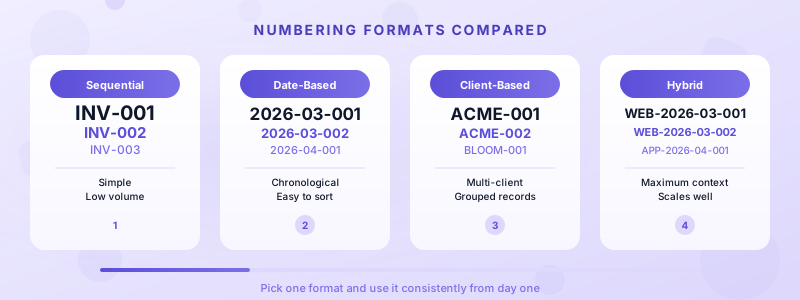
Sequential numbering is the simplest approach. Start at 001 (or 1001 if you want to appear established) and increment by one. This works well for businesses with a single revenue stream and low invoice volume. Example: INV-001, INV-002, INV-003.
Date-based numbering embeds the year, month, or both into the number. This makes it easy to sort invoices chronologically without opening them. Example: 2026-03-001, 2026-03-002. You know instantly that 2026-03-001 was the first invoice issued in March 2026.
Client-based prefixes add a short code for each client. Agencies and consultants who juggle multiple clients love this format because it groups all work for a client together. Example: ACME-001, ACME-002 for Acme Corp, and BLOOM-001 for Bloom Design.
Project-based numbering works for contractors and creative professionals who bill by project. Prefix each invoice with a project code: PROJ-WEB-001 for a website build, PROJ-APP-001 for an app project.
Hybrid formats combine elements. A freelance web developer might use WEB-2026-03-001, which encodes the service type, year, month, and sequence. This format scales well and provides maximum context at a glance.
The format you pick matters less than using it consistently. Choose one and stick with it from your very first invoice.
Five Invoice Numbering Best Practices
These rules apply regardless of which format you choose. Follow them and your records will stay clean as your business grows.
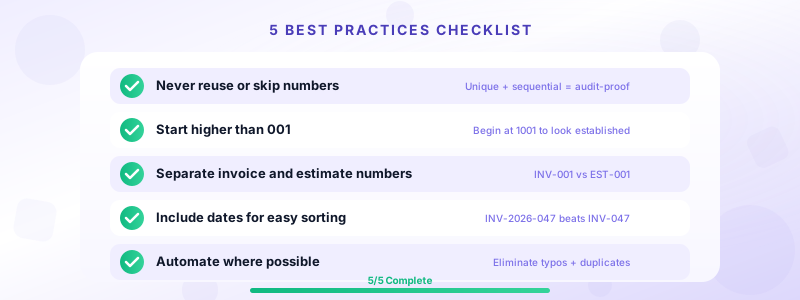
1. Never reuse or skip numbers. Every invoice number must be unique, and gaps in your sequence raise red flags during audits. If you void an invoice, mark it as void in your records rather than reusing its number. Sequential integrity matters.
2. Start higher than 001. Starting at 1001 or 100 is a common tactic for new businesses. It avoids signaling to clients that they are your very first customer, and it gives you room if you ever need to backdate a legitimate invoice.
3. Separate invoice and estimate numbers. Estimates and invoices are different documents with different purposes. Use distinct prefixes like EST-001 for estimates and INV-001 for invoices. This prevents confusion when you convert an estimate into an invoice and ensures both series remain independently sequential.
4. Include dates for easy sorting. Even if your primary format is sequential, embedding the year (at minimum) helps future you. When you are digging through records in 2028, a number like INV-2026-047 instantly tells you when it was issued. Without the date, you would need to open the document.
5. Automate where possible. Manual numbering works when you send a handful of invoices per month. But as volume grows, manual entry introduces typos and duplicates. Tools like Invoices Customers auto-generate sequential numbers for you, eliminating human error entirely.
Common Invoice Numbering Mistakes to Avoid
Even simple numbering systems break down when you make these common errors. Recognizing them early prevents costly cleanups later.
Restarting your sequence each year without a year prefix. If you go from INV-365 in December back to INV-001 in January, you now have two invoices numbered INV-001. Always include the year when you reset: INV-2026-001 and INV-2027-001 are distinct.
Using random or meaningless numbers. Some business owners assign arbitrary numbers like 7493 or 20568. This makes it impossible to sort invoices, spot gaps, or find a specific record quickly. Structured beats random every time.
Letting different team members create their own systems. If you hire a bookkeeper or virtual assistant, make sure they follow your established format. Two people creating invoices with different schemes creates chaos in your records. Document your system and share it with anyone who touches your billing.
Manually numbering invoices in a spreadsheet. Spreadsheets do not warn you about duplicates or enforce sequential order. A dedicated invoicing tool catches these problems before they reach your client. This is one of the most frequent invoicing mistakes small businesses make.
How to Set Up Your System Today
You do not need to overthink this. Pick a format, document it, and start using it on your next invoice. Here is a quick setup process.
First, decide on your format. For most freelancers and small business owners, date-based sequential numbering (2026-03-001) offers the best balance of simplicity and usefulness. If you work with multiple clients on distinct projects, add a client or project prefix.
Second, document your convention. Write down the format, the starting number, and any rules (such as "never reuse voided numbers"). Keep this note wherever you store business records.
Third, use a tool that enforces your system. Invoices Customers assigns sequential invoice numbers automatically, so you never have to think about duplicates or gaps. Each invoice gets the next number in your sequence, and your records stay audit-ready without any manual tracking.
Finally, review quarterly. Glance at your invoice list once per quarter to confirm there are no gaps, duplicates, or formatting inconsistencies. A five-minute check prevents a five-hour cleanup later.
Building a Numbering System That Scales
Your business today might send ten invoices a month. Next year, it could be a hundred. The invoice numbering system best practices in this guide work at any scale because they prioritize consistency and structure over complexity.
Start with a format that fits your current workload. Embed enough context (dates, client codes) to make each number meaningful. Automate the generation so human error stays out of the equation. And make sure anyone involved in your billing follows the same rules.
A well-organized numbering system supports everything else in your business: faster payments, cleaner bookkeeping, smoother audits, and a professional image that builds client trust. To make sure every element of your invoices is covered, check out the full invoice checklist.
Ready to stop numbering invoices by hand? Invoices Customers handles invoice numbering automatically, so you can focus on the work that earns the money.
