
How to Set Freelance Rates That Pay Bills
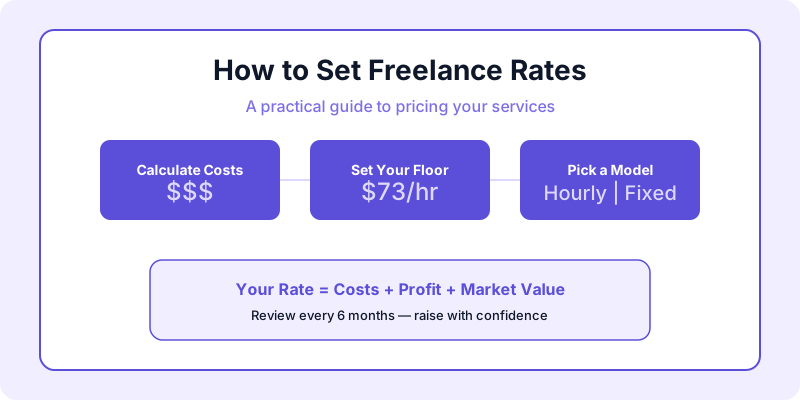
Figuring out how to set freelance rates is one of the most stressful parts of working for yourself. Charge too little and you slowly run out of money. Charge too much without backing it up and potential clients disappear. The uncertainty leads many freelancers to just copy what someone else charges — and that almost never works.
Your rates need to reflect your costs, your skills, and the value you deliver. The good news is that you can calculate all three with straightforward methods. This guide walks you through the exact steps to set freelance rates that cover your expenses, match the market, and grow with your experience.
Calculate Your Minimum Acceptable Rate
Before you pick a pricing model or compare yourself to other freelancers, you need one critical number: your floor rate. This is the absolute lowest you can charge per hour and still keep your business alive.
Here is the formula. Add up every cost you have in a year: rent or mortgage, health insurance, software subscriptions, equipment, retirement contributions, and the after-tax income you actually need to live on. Then add 25 to 30 percent on top for self-employment taxes.
Take that total and divide it by your realistic billable hours per year. Most freelancers can bill between 1,000 and 1,200 hours annually. The remaining time goes to finding clients, handling admin work, taking time off, and dealing with unbillable tasks.
For example, if your annual costs plus desired income total $80,000, and you can bill 1,100 hours per year, your minimum rate is roughly $73 per hour. Write this number down. Every project you take should pay at or above this floor. If a client's budget puts you below it, the project costs you money no matter how exciting it sounds.
This floor rate is not your actual rate. It is your walk-away number. Your real rate should sit comfortably above it.
Four Freelance Pricing Models Compared
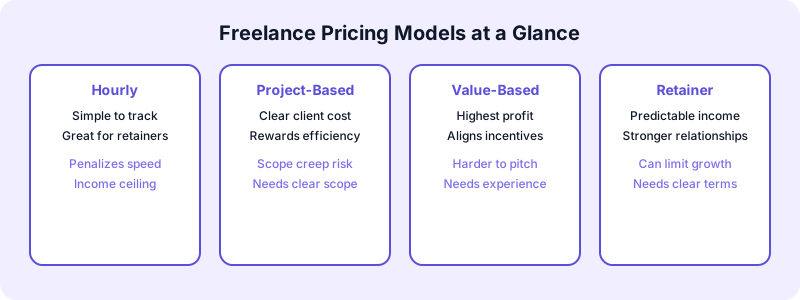
Once you know your floor rate, you need to decide how you present your pricing to clients. Each model has trade-offs, and many experienced freelancers use more than one depending on the project.
Hourly pricing is the simplest approach. You track your time and bill for every hour worked. It works well for ongoing retainer relationships and projects where scope is genuinely unpredictable. The downside is that as you get faster and more skilled, you earn less per project for the same quality of work. Hourly billing rewards slowness, which is backwards.
Project-based pricing means quoting a flat fee for a defined deliverable. Clients like it because they know the total cost upfront. You benefit because efficiency means higher effective hourly earnings. The risk is underestimating scope — always add a 20 to 30 percent buffer to your time estimate when calculating project fees.
Value-based pricing ties your fee to the outcome or value your work creates for the client. If your marketing copy generates $50,000 in new revenue, charging $5,000 is reasonable even if the work only took ten hours. This model requires understanding your client's business goals and having confidence in your results. It is the most profitable model but takes practice to implement.
Retainer agreements lock in a fixed monthly payment for a set amount of availability or deliverables. They provide predictable income and tend to build stronger client relationships. Structure them clearly — for example, 20 hours per month at $90 per hour equals $1,800 monthly.
No single model is best for every situation. Many freelancers quote project fees for new clients and transition to retainers once trust is established.
How to Research What the Market Will Pay
Your rates do not exist in a vacuum. You need to understand what clients in your niche expect to pay and what other freelancers with similar skills charge.
Start with freelance platforms and industry reports. Sites like Glassdoor, Upwork's rate explorer, and industry-specific salary surveys give you ranges for your skill set and experience level. Look at the midpoint of the range rather than the bottom — the lowest rates belong to beginners competing on price alone.
Talk to other freelancers in your field. Join communities, attend meetups, or connect in online groups. Most freelancers are surprisingly open about their rates in private conversations. You will often discover you are charging less than peers with similar experience.
Pay attention to geographic and industry factors. A freelance developer building apps for fintech startups can charge significantly more than one building basic WordPress sites. A freelancer working with enterprise clients in New York charges differently than one serving local small businesses. Your niche and your clients' budgets matter more than general averages.
Finally, test your rates. When you quote a new project price and the client says yes immediately without any negotiation, your rate is probably too low. Aim for a close rate around 60 to 70 percent — that means your pricing is competitive but not leaving money on the table.
When and How to Raise Your Rates
Many freelancers set their rates once and never revisit them. That is a mistake. Your skills improve, your costs increase, and the market shifts. Review your rates at least twice a year.
Here are signs it is time for an increase. You have not raised rates in over a year. Every client says yes without pushing back. You are fully booked with no room for new work. Your effective hourly rate on fixed projects has climbed well past your quoted rate. Or the cost of living in your area has gone up.
When you raise rates, apply the new pricing to new clients immediately. For existing clients, give 30 to 60 days notice. A simple message works: explain that your rates are increasing on a specific date, state the new rate, and thank them for their continued partnership. Most clients expect periodic increases and will not blink at a 10 to 20 percent adjustment.
If you are nervous, start with new clients only. Once you see that prospects still say yes at the higher rate, you will have the confidence to update existing clients too.
The data backs this up. Most freelancers who raise their rates by 20 to 30 percent lose fewer than one in ten clients — and those tend to be the most difficult, lowest-value relationships anyway.
Put Your Rates on Paper With Clear Invoices
Setting the right rate only matters if you communicate it clearly on every invoice. A confusing or incomplete invoice creates doubt about your pricing and slows down payment.
Your invoices should list your rate or project fee prominently, break down line items so the client sees exactly what they are paying for, include your payment terms and due date, and specify any late payment penalties. If you are billing hourly, include the hours worked per task. If you quoted a project fee, reference the original agreement or estimate.
Using a dedicated invoicing tool makes this effortless. Invoices Customers lets you create professional invoices in seconds on your iPhone — add line items with quantities and rates, set payment terms, and generate polished PDFs ready to send. You can even start with an estimate and convert it to an invoice with one tap once the client approves your rates.
When your invoices look professional and clearly reflect your rates, clients take your pricing seriously. Sloppy or vague invoices undermine the credibility you built during the sales process.
If you are just getting started with invoicing as a freelancer, keep it simple: one tool, one consistent format, and send invoices the same day you deliver work. The faster you invoice, the faster you get paid.
For a deeper look at structuring your documents, check out our freelance invoice template guide. And if you want to explore different ways to structure your fees, our guide on pricing freelance services profitably covers five detailed pricing approaches with real numbers.
Set Your Rates With Confidence
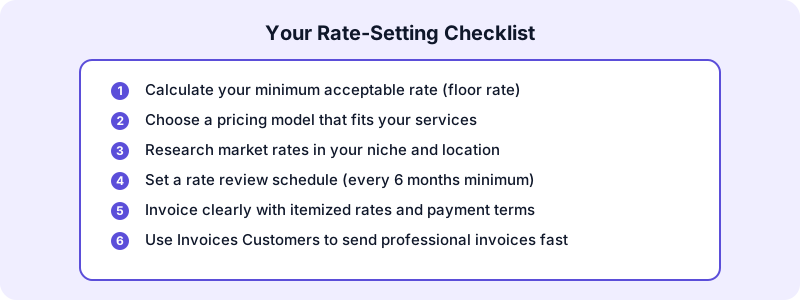
Knowing how to set freelance rates is not about finding one magic number. It is about building a system: calculate your floor, choose a pricing model, research your market, and review regularly. Every freelancer who earns well started by doing this math and adjusting from there.
The biggest mistake is not setting rates too high or too low — it is avoiding the exercise altogether and guessing. Do the work once, and every client conversation about money becomes easier.
Start today. Calculate your minimum rate, pick a pricing model, and put your rates on a professional invoice using Invoices Customers. Your future self will thank you.
