
Small Business Pricing Strategy: A Practical Guide
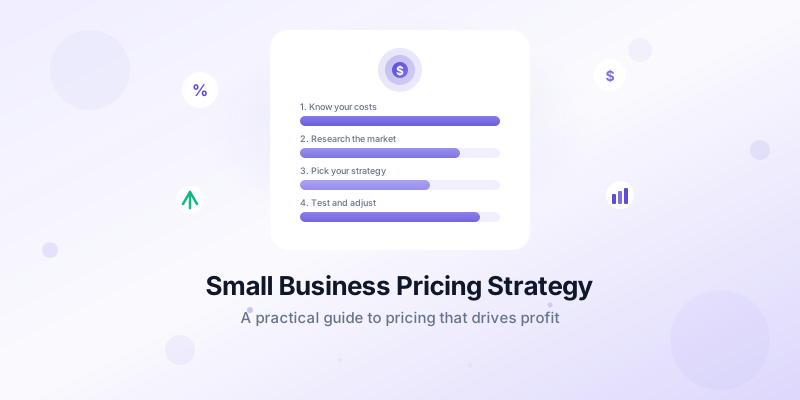
Getting your pricing right is one of the most important decisions you will make as a small business owner. Set prices too low and you work harder for less. Set them too high without justification and prospects move on. A solid small business pricing strategy gives you a framework for finding the number that keeps customers coming back while protecting the margins you need to grow.
The problem is that most small businesses pick a price once and leave it alone for years. Costs change, competitors adjust, and your skills improve, but the number on your invoice stays flat. This guide covers five pricing strategies, helps you choose the right one, and shows you when to adjust.
Know Your Numbers Before You Set a Price
Every pricing strategy starts with the same foundation: understanding your costs. You cannot price profitably if you do not know what profitability requires.
Start by calculating your total cost to deliver your product or service. This includes direct costs like materials, labor, and shipping. It also includes overhead: rent, insurance, software subscriptions, taxes, and the salary you need to pay yourself.
Here is a simple formula. Add up all your annual business costs, including the income you want to take home. Divide that by the number of units you can sell or billable hours you can work in a year. That gives you your break-even price per unit. Everything above that number is profit.
Example. A freelance web developer has $60,000 in annual costs (including personal salary). She can bill roughly 1,100 hours per year. Her break-even rate is $55/hour. Any pricing strategy she uses needs to land above that floor.
If you are selling physical products, the math works the same way. A candle maker who spends $4 on materials, $2 on packaging, and allocates $3 in overhead per unit has a floor cost of $9 per candle. The retail price needs to exceed $9 before any strategy conversation begins.
Write your floor number down. You will reference it as you evaluate each strategy below. Tools like Invoices Customers make it easy to see your revenue per client, which helps you validate that your floor rate is accurate. If you are not tracking your business expenses already, now is the time to start.
Five Pricing Strategies That Work for Small Businesses
There is no single best pricing strategy. The right choice depends on your industry, your competition, and how you want to position your brand. Here are five approaches that work well for small businesses.
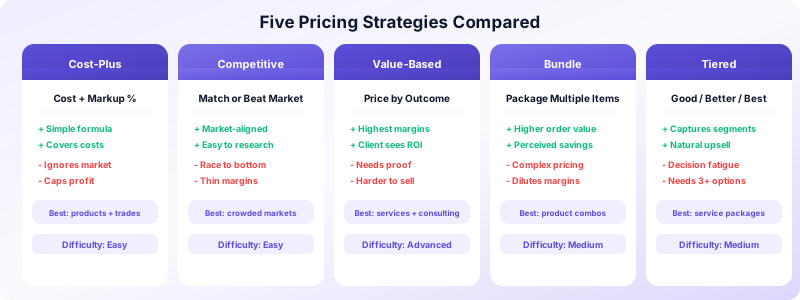
Cost-plus pricing. Add a fixed percentage markup to your total cost per unit. If your cost per unit is $9 and you apply a 50% markup, your price is $13.50. This approach is simple and guarantees that every sale covers costs. It works well for product-based businesses, tradespeople, and contractors who need predictable margins. The downside is that it ignores what the market will actually pay. You might be leaving money on the table.
Competitive pricing. Research what competitors charge and price in the same range, either matching or slightly undercutting their rates. This is straightforward and keeps you relevant. But for small businesses without large-scale cost advantages, competing on the lowest price is a losing game. Use competitive pricing as a reference point, not as your entire strategy.
Value-based pricing. Set your price based on the outcome or benefit your customer receives, not what it costs you to deliver. A consultant who helps a client save $50,000 per year can justify a $5,000 fee even if the work only takes 20 hours. Value-based pricing delivers the highest margins, but it requires proof of results and a clear way to communicate the value. If you already price your freelance services using value metrics, this approach will feel familiar.
Bundle pricing. Package multiple products or services together at a price lower than buying each separately. A photographer might bundle a portrait session, 20 edited photos, and two prints for $800 instead of $1,050 individually. Bundles increase average order value and make customers feel they are getting a deal. Keep your bundles simple and make sure the combined margin still meets your floor.
Tiered pricing. Offer three levels of your product or service, often labeled something like Basic, Standard, and Premium. Most customers choose the middle option, which is exactly the point. Tiered pricing captures different customer segments and creates a natural upsell path. It works especially well for service businesses and subscription models.
How to Choose the Right Strategy for Your Business
Picking a strategy is not about finding the theoretically best approach. It is about matching your pricing model to your business reality.
If you sell physical products, start with cost-plus pricing. It is the easiest to implement and ensures every unit sold is profitable. As you learn what customers are willing to pay, layer in competitive or value-based adjustments.
If you sell services, value-based or tiered pricing will typically earn you more than hourly rates. Clients care about results, not hours. Package your services into defined deliverables with clear outcomes.
If you are in a crowded market, competitive pricing gives you a baseline, but differentiate on something other than price. Faster turnaround, better customer service, or niche specialization all justify a premium. Competing purely on price in a commoditized market will squeeze your margins until the business is not sustainable.
If you are just starting out, do not overthink it. Use cost-plus or competitive pricing to start generating revenue. You can always adjust once you have data on customer behavior and market demand.
Whichever strategy you choose, make sure it connects to your cash flow management plan. Pricing decisions affect when and how much money flows into your business, so align your payment terms accordingly.
When and How to Raise Your Prices
Most small business owners wait too long to raise prices. They worry about losing customers, so they absorb cost increases, work longer hours, and watch their margins shrink. But raising prices strategically is a sign of a healthy, growing business.
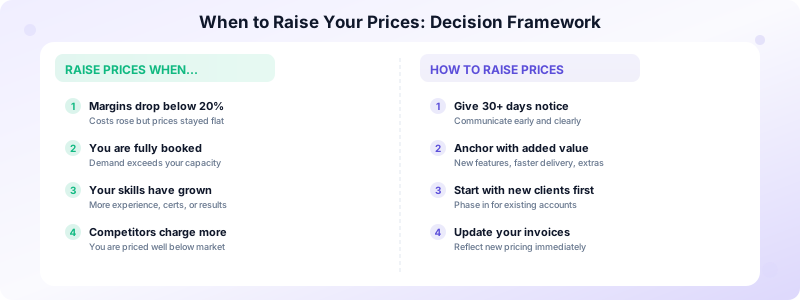
Signs it is time to raise prices. Your profit margins have dropped below 20%. You are fully booked with no room for new work. Your skills, certifications, or product quality have improved since you last set prices. Competitors in your space are charging noticeably more than you.
How to do it without losing clients. Give existing customers at least 30 days notice before the new rate takes effect. Pair the increase with added value: improved quality, faster delivery, or an additional feature. Apply new pricing to incoming clients first, then phase it in for existing accounts. Most clients expect periodic price adjustments, and the ones who leave over a reasonable increase were probably not your best-fit customers anyway.
How much to raise. For service businesses, 5-15% annually is standard. For products, base increases on actual cost changes plus your target margin. If your costs rose 8% and you want to maintain margins, raise prices by at least 8%. Once you decide on new rates, update your line items in Invoices Customers so every future invoice reflects the change automatically.
Turn Your Pricing Strategy Into Professional Invoices
A pricing strategy only works if you communicate it clearly on every invoice you send. Your invoice is where your pricing meets the real world: line items, quantities, rates, and totals that the client actually sees and pays.
Here is how to make your invoices reinforce your pricing strategy. Use clear, descriptive line items that reflect the value you deliver, not just the task performed. Instead of listing "consulting hours," write "brand strategy audit and recommendations." Clients pay more willingly when they see what they are getting.
Include your payment terms directly on the invoice. Whether you use Net 15, Net 30, or due-on-receipt terms, putting the expectation in writing reduces late payments and supports your cash flow.
If you use tiered or bundle pricing, break out each component so the client sees the individual value alongside the total price. This transparency builds trust and makes the bundle feel like a genuine deal rather than an arbitrary number.
With Invoices Customers, you can create professional invoices that reflect your pricing strategy in seconds. Add detailed line items with quantities, rates, and tax. Save client details so you do not have to re-enter them every time. When you raise your prices, update your templates and every new invoice automatically reflects the change. Invoices Customers stores everything locally on your device, works offline, and requires no account to get started.
Your pricing strategy drives your business. Your invoices make it real. Get both right, and you build a business that pays you what you are worth.
