
Tax Invoice Requirements by Country: What to Know
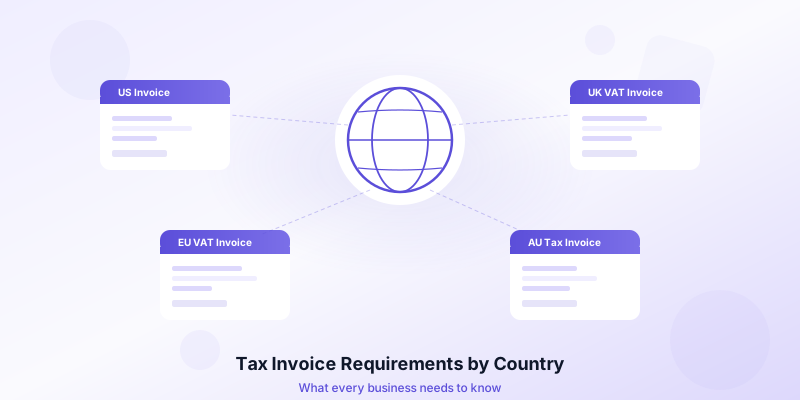
If you sell to clients in more than one country, or even if you only invoice domestically, you need to understand the tax invoice requirements that apply where you do business. Getting it wrong can mean rejected invoices, delayed payments, or penalties from tax authorities.
The good news is that most countries share a core set of required fields. Once you learn the pattern, adapting your invoices for any market becomes straightforward. This guide breaks down what tax invoices must include in the United States, United Kingdom, European Union, Australia, and Canada so you can invoice with confidence everywhere you operate.
What Is a Tax Invoice and Why Does It Matter?
A tax invoice is a document that records a transaction between a seller and a buyer and includes the tax details that both parties need for compliance. In countries that use value-added tax (VAT) or goods and services tax (GST), the tax invoice is the document buyers rely on to reclaim input tax credits. Without a valid tax invoice, your clients may not be able to deduct the tax they paid, which creates friction and erodes trust.
Even in the United States, where there is no federal VAT, including tax information on invoices is considered standard practice. State sales tax rules vary, and a well-structured invoice protects you during audits. Whether you call it a tax invoice, a VAT invoice, or simply an invoice, the principle is the same: include every field the local tax authority expects to see.
If you are starting from scratch, review our guide on what to include on an invoice for a universal checklist you can adapt to any country.
United States: Invoice Requirements
The US has no single federal invoicing law. There is no VAT system, and the IRS does not mandate a specific invoice format. However, state sales tax rules require you to document tax collected on taxable goods and services, and best practice calls for a complete set of fields.
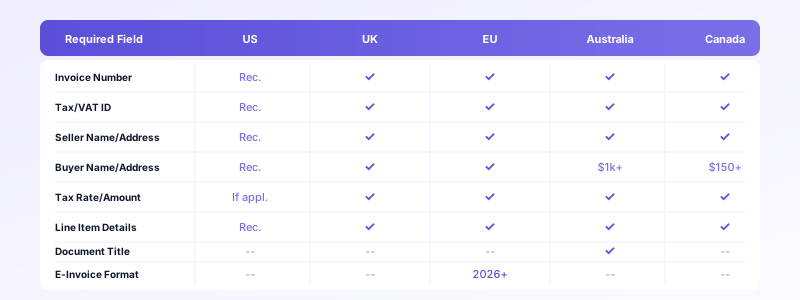
A compliant US invoice should include your business name and address, the client name and address, a unique invoice number, the invoice date, a description of goods or services delivered, quantities and unit prices, applicable sales tax rate and amount, the total amount due, and your payment terms. If your state requires a seller permit or resale certificate number, include that as well.
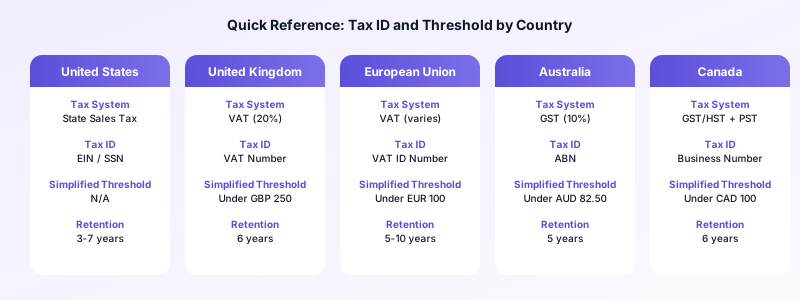
Most states expect you to keep invoices on file for three to seven years for audit purposes. Using sequential invoice numbers makes record-keeping much easier.
United Kingdom: VAT Invoice Rules
In the UK, businesses registered for VAT must issue a VAT invoice for any taxable supply over 250 GBP. Invoices below that threshold can use a simplified format, but full VAT invoices are the standard for business-to-business transactions.
A full UK VAT invoice must include your business name and address, your VAT registration number, the invoice date and a sequential invoice number, the client name and address, a description of goods or services including quantity and price, the VAT rate applied to each line item, the total excluding VAT, the VAT amount, and the total including VAT.
If you supply goods or services at different VAT rates (standard, reduced, or zero-rated), each rate must be broken out separately on the invoice. The UK also recognizes simplified invoices for supplies under 250 GBP, which require fewer fields but must still show your VAT number and the gross amount.
European Union: VAT Invoice Standards
The EU harmonized invoicing rules through the VAT Directive, which means every member state shares a common baseline. A compliant EU VAT invoice must include the date of issue, a unique sequential invoice number, the supplier VAT identification number, the customer VAT number for cross-border B2B supplies, the full name and address of both parties, a clear description of goods or services, the date of supply if different from the invoice date, the taxable amount for each VAT rate, the applicable VAT rate, and the total VAT amount.
For intra-community supplies where the reverse charge mechanism applies, you must note that the customer is responsible for accounting for VAT. The phrase varies by language, but the requirement is universal across all 27 member states.
Several EU countries are also rolling out mandatory e-invoicing. France begins phased enforcement in September 2026, Belgium requires it from January 2026, and Germany mandates e-invoice acceptance starting in 2025 with sending requirements following in 2027. If you invoice clients in these markets, structured electronic formats like Peppol BIS or UBL are becoming the legal baseline.
Australia: GST Tax Invoice Rules
Australia requires businesses registered for GST to issue a tax invoice for any taxable sale of 82.50 AUD or more (including GST). The document must be titled "Tax Invoice" to be legally valid.
Required fields include the supplier name, Australian Business Number (ABN), and address, the invoice date, a description of goods or services, the quantity and price of each item, the GST amount for each line or a statement that the total includes GST, and the total amount payable. For sales of 1,000 AUD or more, you must also include the buyer ABN.
A critical detail: if a supplier invoice is missing the ABN, the buyer must withhold 47 percent of the payment and remit it directly to the Australian Taxation Office. This makes the ABN the single most important field on an Australian tax invoice. Double-check it every time.
Invoices must be issued within 28 days of the supply date. Keep records for at least five years, as the ATO can audit that far back.
Canada: GST and HST Invoice Requirements
Canada uses a dual system of federal GST and provincial sales taxes, combined in some provinces as HST. Businesses registered for GST or HST must include their Business Number (BN) on invoices.
For supplies under 100 CAD, a simplified invoice showing the supplier name, invoice date, and total amount is sufficient. Between 100 CAD and 150 CAD, you must add the GST or HST registration number and the tax amount or rate. For supplies over 150 CAD, a full invoice is required with the buyer name and address, payment terms, and a breakdown of each tax applied.
Quebec has its own system, the QST, which requires a separate provincial registration number on invoices. If you invoice clients in Quebec, include both your federal BN and your QST number.
How to Stay Compliant Across Multiple Countries
If you invoice clients in more than one country, build a master invoice template that includes every possible field. It is always safer to include more information than less. No tax authority will penalize you for adding extra details, but they will flag you for missing required ones.
Start with these steps. First, identify every country where your clients are located. Second, check whether that country uses VAT, GST, or a sales tax system. Third, confirm which fields are legally required and add them to your template. Fourth, set up your invoice numbering to be sequential and easy to trace. Fifth, store copies of every invoice for the maximum retention period any of your operating countries requires.
When working across borders, you also need to handle currency correctly. Show the amount in the agreed currency and, if required, include the exchange rate and equivalent amount in the local currency.
Using a tool that handles these details automatically saves you from compliance headaches. Invoices Customers lets you create professional invoices with all the critical fields, generate polished PDFs, and manage client details from your iPhone. You build the template once with the right fields, and every invoice you send from that point forward stays consistent and complete.
For businesses that deal with creating professional invoices across markets, having a reliable system is not optional. It is the difference between getting paid on time and chasing rejected invoices.
Keep Your Invoices Compliant Everywhere
Tax invoice requirements by country follow a predictable pattern once you understand the basics. Most countries require your business identity, a unique invoice number, a clear description of the supply, and a tax breakdown. The differences come down to specific tax ID formats, thresholds for simplified invoices, and whether e-invoicing is mandatory.
The simplest approach is to always include the maximum set of fields. Your US clients will not mind seeing a tax breakdown, and your EU clients need it. By building one thorough template, you stay compliant everywhere without juggling multiple formats.
Download Invoices Customers and create tax-compliant invoices from your iPhone in seconds, no matter where your clients are located.
