
How to Handle Client Disputes on Invoices
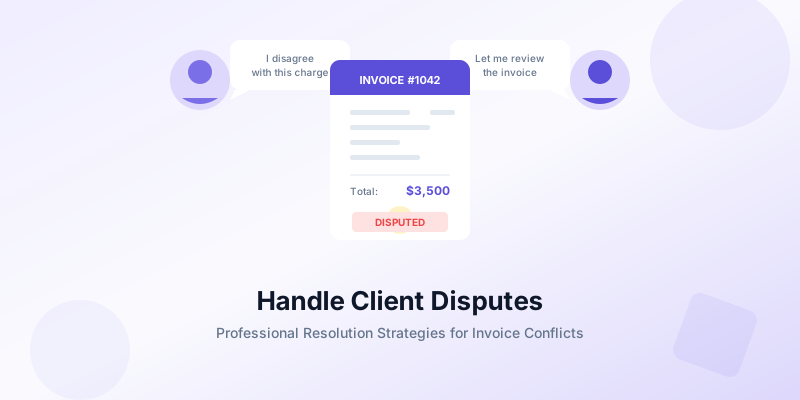
Every freelancer and small business owner dreads the moment a client pushes back on an invoice. Whether the disagreement is about the total amount, the scope of work, or a line item they did not expect, knowing how to handle client disputes on invoices protects both your revenue and your reputation. The good news is that most billing disagreements are resolvable — if you respond quickly and professionally.
This guide walks you through a proven process for resolving invoice disputes, preventing them from happening in the first place, and keeping your client relationships intact along the way.
Understand Why Clients Dispute Invoices
Before you respond to a disputed invoice, take a step back and identify the root cause. Client disputes on invoices usually fall into a few common categories.
Scope disagreements happen when the client believes the work you billed for was not part of the original agreement. This is especially common in projects where the scope evolved through verbal conversations rather than written updates.
Pricing surprises occur when the final total exceeds what the client expected. Maybe you charged for additional revisions, travel time, or materials that were not discussed upfront.
Quality concerns arise when the client feels the delivered work did not meet their expectations and they question the value of what they are paying for.
Administrative errors are the simplest to fix. A typo in a line item, a duplicate charge, or the wrong tax rate can trigger a dispute that takes five minutes to resolve once identified.
Understanding the category helps you choose the right response. An honest billing mistake calls for a quick correction and apology. A scope disagreement requires documentation and a professional conversation.
Respond Quickly and Professionally
Speed matters when a client raises a billing concern. The longer you wait to respond, the more frustrated the client becomes — and the harder the dispute is to resolve.
Follow these steps the moment you receive a dispute.
Acknowledge the concern within 24 hours. Even if you need time to review the details, a simple message confirming that you received their feedback and are looking into it sets the right tone.
Stay calm and avoid defensive language. Phrases like "as I clearly stated" or "you should have known" escalate conflicts. Use neutral language instead: "Let me review the project details so we can sort this out."
Gather your documentation. Pull together the original estimate or contract, any emails where scope changes were discussed, and the invoice itself. Facts resolve disputes faster than opinions.
Schedule a call if needed. Some disputes are too nuanced for email threads. A 15-minute phone call often resolves what days of back-and-forth messages cannot.
The goal is not to win the argument. The goal is to reach a fair outcome that preserves the relationship and gets you paid.
Document Scope Changes in Writing
Most invoice disputes trace back to one problem: scope creep that was never documented. You agreed to build a website with five pages, the client asked for a sixth page over Slack, and now they do not want to pay for it.
The fix is simple in theory and hard in practice: get every change in writing before you do the work.
When a client requests something outside the original agreement, send a brief message confirming the change and its cost. Something like: "Happy to add that extra page. It will add $400 and two additional days to the timeline. Want me to go ahead?" Save the response.
If you use estimates before starting projects, this process becomes even smoother. You can create a revised estimate that reflects the new scope, send it for approval, and then convert it to an invoice when the project is complete. That paper trail eliminates ambiguity.
Tools like Invoices Customers make this straightforward. You can create detailed estimates with line items, share them with clients for approval, and convert approved estimates into invoices with a single tap. Every line item is documented and agreed upon before billing.
Know When to Negotiate and When to Stand Firm
Not every dispute requires you to adjust your invoice. Some situations call for flexibility, others demand firmness.
Consider adjusting when:
- You made a genuine billing error.
- The scope change was discussed verbally but never confirmed in writing, and the client's interpretation is reasonable.
- The amount in question is small relative to the total project value, and the client relationship is worth preserving.
- You delivered late or below the agreed quality standard.
Stand firm when:
- You have written documentation showing the client approved the scope and pricing.
- The client is disputing charges for completed, quality work that matches the agreement.
- The client has a pattern of disputing invoices as a negotiation tactic.
When you do offer a concession, frame it positively. Instead of saying "Fine, I'll remove the charge," say "I want to make this right. I will credit the revision charges on this invoice, and going forward we will document scope changes before I begin work." This protects future projects while resolving the current issue.
If you cannot reach an agreement and the amount is significant, consult a legal professional. For smaller amounts, weigh the cost of further effort against the outstanding balance and make a business decision.
Prevent Disputes With Clear Invoicing Practices
The best way to handle a billing dispute is to prevent it entirely. Here are practices that drastically reduce the chance of a disagreement.
Use detailed line items. Vague descriptions like "consulting services" invite questions. Specific entries like "Brand strategy workshop — 3 hours" leave little room for misunderstanding. A well-structured invoice eliminates most common invoicing mistakes.
Set payment terms upfront. Define when payment is due, what late fees apply, and how disputes should be raised. Put these in your contract and reference them on every invoice. Clear payment terms set expectations from day one.
Send invoices promptly. The longer you wait to bill after completing work, the hazier the client's memory of what was delivered. Invoice within a week of project completion whenever possible.
Include supporting materials. For large projects, attach a brief summary of deliverables alongside your invoice. This reminds the client of the value they received and preempts questions.
Request deposits for large projects. A deposit invoice confirms client commitment and reduces your risk on high-value work. It also establishes the billing relationship early.
Protect Your Business and Your Client Relationships
Handling client disputes on invoices is not just about getting paid for a single project. It is about building a reputation as someone who is fair, organized, and easy to work with. Clients talk. How you handle a disagreement determines whether they send you referrals or warn others away.
Keep records of every project: the original agreement, scope changes, estimates, and final invoices. Store client details in a system you can access instantly — not buried in email threads. When a question arises, you want to pull up the facts in minutes, not hours.
Use a tool that ties your client information, estimates, and invoices together. Invoices Customers keeps everything connected on your iPhone — client records, estimate history, and invoice tracking — so you always have the documentation you need. It works offline, requires no account, and stores your data privately on your device.
The next time a client questions a charge, you will not panic. You will pull up the estimate they approved, walk through the line items, and resolve the issue professionally. That is how you handle client disputes on invoices — with preparation, documentation, and the right tools. Download Invoices Customers from the App Store and start building that documentation habit today.
